
Flooring Contractor Insurance by State
Illinois Flooring Contractor Insurance
Illinois licenses no flooring contractors, yet its home repair law, the home rule cities and counties, EPA, the state asbestos rules and the workers’ compensation law all reach a flooring business.
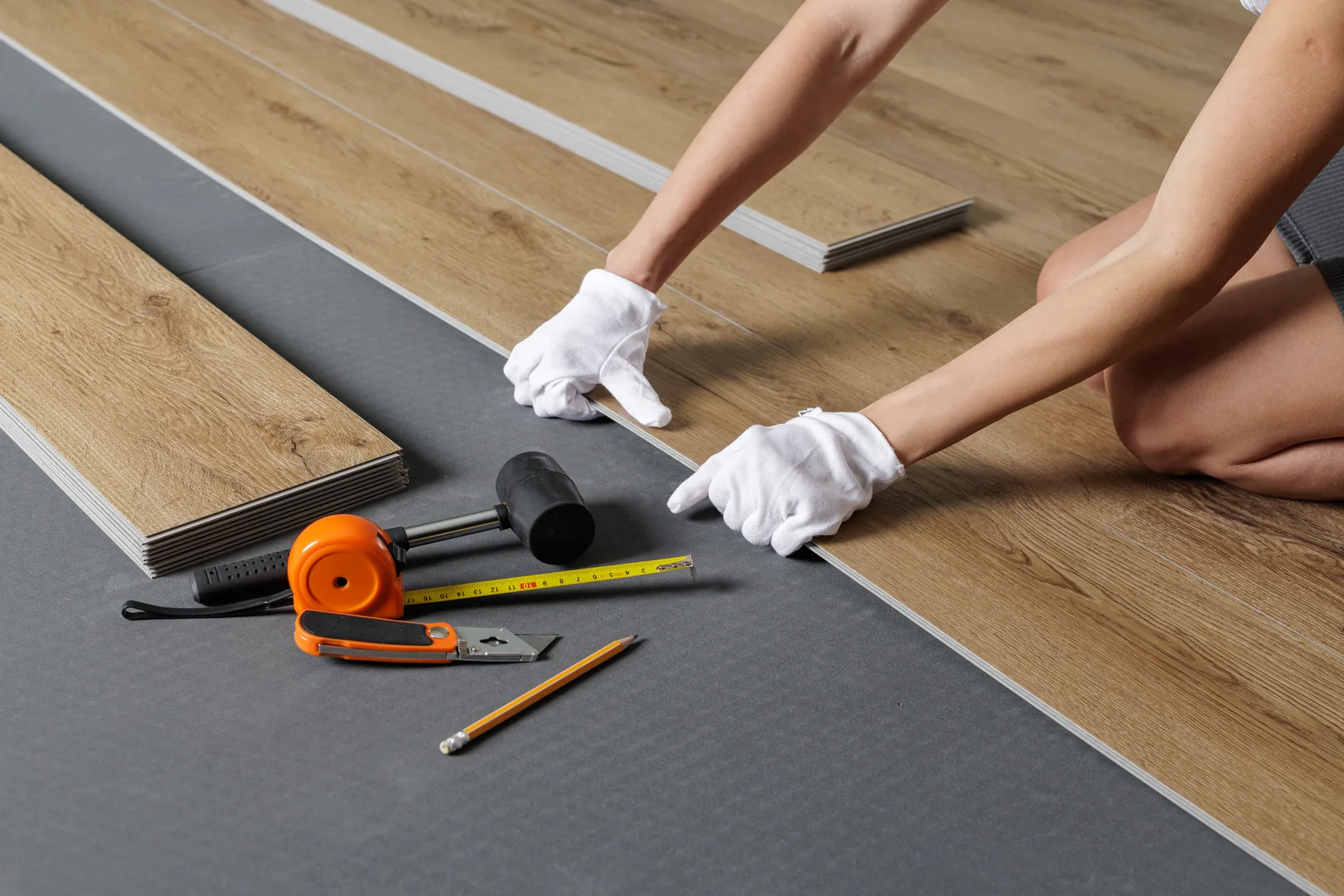
Illinois licenses no flooring contractors, but its Home Repair and Remodeling Act still reaches a business that repairs or remodels homes: it must carry public liability and property damage insurance and hand the customer a written contract or work order that states the total cost, and the Act’s definition leaves the sale, installation, cleaning and repair of carpets outside it. Around that statewide rule, home rule cities and counties may license contractors themselves (Chicago requires a general contractor license for most building work in the city), lead-safe renovation certification comes from EPA, the state asbestos rules reach floor tile removal in part, and workers’ compensation applies automatically to employers who remodel or alter structures and is bought from the private market.
Here the licensing question and the insurance question arrive together: a home repair statute with no license attached names the insurance itself, which is why this page begins with it. It also stops short in a way that matters to one part of the trade, and where it stops is quoted below in its own words.
What the policies do for a flooring business wherever it works lives on the flooring contractor insurance page and the pages linked from it. The sections here stay with Illinois, in the order an owner meets it: the licensing and home repair rules, lead paint at the edges of a floor, asbestos under it, the crew’s workers’ compensation, the agencies, and the metro areas. They are written for a residential flooring contractor working in occupied houses and condominiums, a commercial flooring firm bidding to general contractors, a carpet installation business and a tile and stone setter alike.
Illinois licenses no flooring contractors, but its home repair law names the insurance
Illinois has no statewide contractor license or registration that reaches flooring installation. The Illinois Department of Financial and Professional Regulation’s list of regulated professions includes roofing contractors, home inspection and interior designers, and no general, building or flooring contractor license.
Authority: 815 ILCS 513/10; 815 ILCS 513/15; 815 ILCS 513/25; Ill. Const. art. VII, § 6(a)
That finding is not an open field. The Home Repair and Remodeling Act is not a license and issues nothing to hang on the office wall, yet its duties attach to the business itself, and it starts from a broad definition of the work it reaches:
“"Home repair and remodeling" means the fixing, replacing, altering, converting, modernizing, improving, or making of an addition to any real property primarily designed or used as a residence …”
Fixing, replacing, altering and improving describe a great deal of what a residential flooring crew does in a week. The same definition then sets one trade apart by name:
“"Home repair and remodeling" does not include the sale, installation, cleaning, or repair of carpets”
That is the sentence a carpet installation business should keep in the office file. The carve-out names carpets, and the Act’s definition speaks for itself on everything else; whether a particular hardwood, vinyl, laminate or tile job sits inside the definition is a reading of the statute against the job, and this page does not make it for you. If a residential job mixes carpet with other floor coverings, settle how the contract describes the work before anyone signs it.
For a business the Act does reach, the two duties that matter most to an owner are insurance and paper. The insurance duty comes first:
“Any person engaged in the business of home repair and remodeling shall obtain and maintain in full force and effect during the operation of the business public liability and property damage insurance”
The duty runs for as long as the business operates, which makes the coverage a standing condition rather than something bought job by job. What a general liability policy does, and how it treats injury and property damage claims arising from finished floors, is set out on that page; the point for Illinois is that the Act asks for the coverage to be in force the whole time you trade. The paper duty follows:
“a person engaged in the business of home repair or remodeling shall furnish to the customer for signature a written contract or work order that states the total cost”
The simplest habit is a written work order with the total cost on every residential job.
Above the statewide layer sits a local one. The Illinois Constitution gives home rule units a broad grant of power, including the power to license:
“Except as limited by this Section, a home rule unit may exercise any power and perform any function pertaining to its government and affairs including, but not limited to, the power to regulate for the protection of the public health, safety, morals and welfare; to license; to tax; and to incur debt.”
The City of Chicago Department of Buildings uses that power:
“A City of Chicago general contractor license is required to perform most types of building construction, alteration, repair, and demolition work within the City of Chicago.”
Chicago is the example the record verified, not the only city that may license. A firm that crosses municipal lines should treat each new city or county as a question to put to its building department at the bid stage:
- Ask the building department whether it licenses or registers contractors for the work you are quoting, and whether a subcontractor needs anything of its own.
- On a job run by a general contractor inside Chicago, confirm in writing whose license and permit the flooring work is done under.
- For residential work, keep the signed contract or work order and the certificate of insurance in the same job folder; the Act asks for both, and a homeowner may ask to see either.
Proof of coverage for a general contractor, and the additional insured wording that tends to travel with a commercial subcontract, is covered on the commercial flooring contractor insurance page; what a homeowner may ask to see is on the residential page.
Lead paint on an Illinois flooring job: EPA certifies the renovator, the state licenses abatement
Illinois is not an EPA-authorized RRP state, so EPA itself administers the lead renovation, repair and painting (RRP) program there, and the lead-safe certification a flooring firm needs for covered renovation work comes from EPA.
Authority: 410 ILCS 45/11.1; 40 CFR Part 745
The reason sits in EPA’s own list of the states it has authorized to run the program themselves. Illinois is not on it:
“EPA administers the RRP Program in most Tribes, states and territories, but has authorized the following to operate their own programs: Alabama, Delaware, Georgia, Iowa, Kansas, Massachusetts, Mississippi, North Carolina, Oklahoma, Oregon, Rhode Island, Utah, Vermont, Wisconsin and the Minnesota Chippewa Tribe-Boise Forte (Nette Lake).”
The state program licenses a different set of people, and the Illinois Department of Public Health describes it this way:
“The Program also licenses lead paint inspectors, lead risk assessors, lead abatement contractors, lead supervisors, and lead workers and approves lead training courses for individuals.”
Those are the trades whose work is the lead itself. A flooring business meets lead at the margins of the job instead: the baseboard pried off so the new floor can run to the wall, the painted door that has to be trimmed to clear a thicker floor, the shoe molding that goes back on at the end. The same department makes a point that belongs on any walkthrough of an older house:
“Even the deepest layers of lead-based paint can be disturbed during remodeling or home repair.”
Whether a given job falls under the federal renovation rule turns on facts about the building and the work, which this page cannot settle. What an owner can settle is who holds the EPA certification and whether that person is on the jobs that need it. Questions for the walkthrough:
- How old is the house, and has anyone tested the trim or the doors?
- Is your crew taking off and reinstalling the painted trim, or is another trade handling it?
- Is the certified person from your firm scheduled for this job, not only on the books?
The way a general liability policy treats a claim involving lead is its own subject and is taken up on that page, and the residential flooring page spends time on older homes for the same reason.
Old floor tile and the Illinois asbestos rules: federal methods, state notice, and a friable line
The asbestos program Illinois runs reaches flooring removal in part. The Illinois Department of Public Health licenses asbestos abatement contractors, supervisors and workers for commercial and public buildings, but its rule leaves the removal of nonfriable resilient floor covering to the federal EPA and OSHA requirements while keeping the state notification duty for those removals. The same rule counts nonfriable material that will be sanded, ground, cut or otherwise reduced to powder as friable. The Illinois EPA enforces the federal emission standard for asbestos in demolition and renovation, and detached homes and smaller apartment buildings fall outside the state licensing law and that standard.
Authority: 77 Ill. Adm. Code 855.5(e); 77 Ill. Adm. Code 855.20; 225 ILCS 207/15; 225 ILCS 207/35
Three pieces of that finding matter to a flooring crew, and each has its own source. The first is the carve-out the Illinois Department of Public Health asbestos program wrote into its rule for the material a flooring crew handles most:
“Notwithstanding any other provision of Part 855, the asbestos requirements established by USEPA and OSHA and incorporated by reference in Section 855.10(a) of this Part shall govern the repair, maintenance, and removal of nonfriable resilient floor covering materials and persons designing, planning, contracting, supervising and/or performing such activities and related inspections. The notification requirements set forth in Sections 855.220(a) and (b) and 855.330(c) shall apply to such removals as applicable.”
The effect is a split. For intact resilient floor covering, the federal EPA and OSHA requirements govern how it is repaired, maintained and removed, and the state still expects to be notified. The second piece is the line that decides whether material stays in that category:
“The term includes nonfriable asbestos-containing materials which will be subjected to sanding, grinding, cutting, abrading, drilling, chipping, pulverizing, or other procedures likely to reduce these materials to a powder or cause asbestos fibers to become airborne.”
That list reads like a tear-out gone badly: sanding, grinding, cutting, chipping. The method a crew picks for getting old tile off the slab is therefore the choice the rule itself looks at, and the record stops short of saying how a particular sanded or ground job is then licensed. Agree the removal method in writing before the job starts, and if the tile does not come up the way the proposal assumed, stop and talk to the owner before the method changes.
The third piece is who may do abatement work in the buildings the state law reaches:
“No person may act as an asbestos abatement contractor providing response action services unless the person is licensed as an Asbestos Abatement Contractor by the Department”
The federal emission standard is enforced in Illinois by the Illinois Environmental Protection Agency, under a delegation it describes in these words:
“The Illinois EPA is the United States Environmental Protection Agency (USEPA) delegated authority to enforce the National Emission Standards for Hazardous Air Pollutants (NESHAP) for regulated asbestos during demolition, renovation and disposal.”
And the same agency tells homeowners and small landlords where that standard stops:
“The National Emission Standards for Hazardous Air Pollutants (NESHAP) and other asbestos-related regulations do not apply to privately owned homes and apartments with four or less units.”
Those exemptions are about which rules apply to the building, not about what is under an old floor. A crew taking up a floor in a house still makes the same practical choices about method and dust, which is part of why the residential page treats older homes on their own. Habits that help on either side of the line:
- In a commercial or public building, ask for whatever inspection or survey the owner holds before pricing the removal, and read what it says about the flooring layers.
- Write the chosen removal method into the proposal itself, so there is no later argument about whether the crew was hired to grind.
- Pass along to the crew lead what is known about the floor before the first day, including anything found under a previous layer.
An asbestos-related claim under a general liability policy is a question for that page; the general contractor’s requirements on a commercial tear-out are on the commercial page, and old tile demolition is on the tile and stone page.
Illinois workers’ compensation for a flooring crew: automatic, and bought privately
Authority: 820 ILCS 305/3; 820 ILCS 305/4(a)
The Illinois Workers’ Compensation Act does not wait for an employer in the trades it names to choose it. It applies on its own terms:
“The provisions of this Act hereinafter following shall apply automatically and without election to … all employers and all their employees, engaged in any department of the following enterprises or businesses which are declared to be extra hazardous”
The list that follows those words begins with the kind of work a flooring business does every day:
“The erection, maintaining, removing, remodeling, altering or demolishing of any structure.”
For a flooring business, the words to notice are remodeling and altering. The Illinois Workers’ Compensation Commission puts the threshold plainly on its own page:
“If you have one employee, even a part-time employee, you must obtain workers' compensation insurance.”
The Act then sets out how an employer secures the obligation. The first route reads this way in the statute:
“Insure his entire liability to pay such compensation in some insurance carrier authorized, licensed, or permitted to do such insurance business in this State.”
The other route, carrying the risk yourself, runs through the Commission:
“File with the Commission annually an application for approval as a self-insurer”
There is no state fund in Illinois to buy from instead, and the Commission says where the coverage comes from:
“In Illinois, w.c. insurance is sold in the private sector.”
In practice that puts workers’ compensation in the same place as the rest of the program: placed with an insurer authorized to write the coverage in Illinois, through the private market. Payroll underwriting for flooring, and how installers paid as subcontractors are treated, including why their own certificates matter to your policy, is on the workers’ compensation page, since those are questions about the policy rather than about Illinois.
Every finding here stops at the Illinois line. A crew that also works in a neighboring state meets that state’s rules on their own terms.
The Illinois agencies behind these rules, and what each one handles
The Illinois Department of Insurance is the state’s insurance regulator. An insurance agency’s license, ours included, can be checked on NIPR.com.
The rest of the offices this page relies on each hold one part of the picture. The links go to their own sites, and the roles are the ones the record verified:
- Illinois Department of Financial and Professional Regulation: statewide professional licensing, including roofing contractors (no general or flooring contractor license)
- Illinois Department of Public Health: state lead program: licensing of lead inspectors, risk assessors, abatement contractors, supervisors and workers; RRP itself is EPA-administered
- Illinois Department of Public Health asbestos program: asbestos abatement licensing and notification for schools and commercial and public buildings
- Illinois Environmental Protection Agency: state environmental agency; delegated enforcement of the federal asbestos emission standard for demolition and renovation
- Illinois Workers’ Compensation Commission: workers’ compensation dispute resolution, insurance compliance and self-insurance approval
Missing from the list, deliberately, is a state board that licenses flooring or general contractors, since the licensing section found none, and a state workers’ compensation fund, since there is none.
Flooring markets across Illinois, metro by metro
Below are the state’s largest metropolitan areas with a principal city in Illinois, as the U.S. Census Bureau delineates them. A metro that reaches into another state lists only its Illinois counties here, because the rules on this page are the Illinois ones.
Chicago-Naperville-Elgin, IL-IN
The metro’s Illinois counties: Cook County, DeKalb County, DuPage County, Grundy County, Kane County, Kendall County, Lake County, McHenry County and Will County.
No state contractor license; a home rule city or county may license contractors, and the home repair law’s insurance and contract duties apply statewide.
Inside the city of Chicago, the City of Chicago Department of Buildings requires a general contractor license for most building construction, alteration, repair and demolition work in the city, which reaches general contractors and the flooring work done under their permits.
Davenport-Moline-Rock Island, IA-IL
The metro’s Illinois counties: Henry County, Mercer County and Rock Island County.
No state contractor license; a home rule city or county may license contractors, and the home repair law’s insurance and contract duties apply statewide.
Peoria, IL
The metro’s counties: Marshall County, Peoria County, Stark County, Tazewell County and Woodford County.
No state contractor license; a home rule city or county may license contractors, and the home repair law’s insurance and contract duties apply statewide.
Rockford, IL
The metro’s counties: Boone County and Winnebago County.
No state contractor license; a home rule city or county may license contractors, and the home repair law’s insurance and contract duties apply statewide.
Champaign-Urbana, IL
The metro’s counties: Champaign County, Ford County and Piatt County.
No state contractor license; a home rule city or county may license contractors, and the home repair law’s insurance and contract duties apply statewide.
Springfield, IL
The metro’s counties: Menard County and Sangamon County.
No state contractor license; a home rule city or county may license contractors, and the home repair law’s insurance and contract duties apply statewide.
Building the insurance side of an Illinois flooring business
The sections above locate the rules. The policies that answer for the work are the ones a flooring business carries in any state, and each has a page of its own:
- General liability, the coverage for injury and damage to others, including finished work and tear-out.
- Workers’ compensation: covering the crew, and the question of subcontracted installers.
- Inland marine, written as contractors’ tools and equipment coverage, for the saws, scrapers, floor sanders and material that move from one job to the next.
The weight each one carries depends on the work. A carpet installation business working in homes, a tile and stone setter on commercial jobs and a residential crew doing remodels meet different owners and different floors, and the service pages take them one at a time. For Illinois work, the quote request is where it comes together.
Residential Flooring Contractor Insurance
A panel for Illinois in rows. Contractor license: no statewide license reaches this work. It connects to the General Liability page. Lead-safe renovation: the federal program applies in this state. It connects to the Residential Flooring Contractor Insurance page. Asbestos flooring and mastic: a state program reaches flooring removal. It connects to the General Liability page. Workers’ compensation: bought in the open market. It connects to the Workers Compensation page. Each row pairs a state rule with the page on this site that discusses it. No figures are shown.
Related coverage and services
What we insure
Coverage lines
Illinois flooring contractor insurance questions
Is there an Illinois state license for installing floors?
No. The Illinois Department of Financial and Professional Regulation regulates a list of professions that includes roofing contractors, home inspection and interior designers, and it has no general, building or flooring contractor license on it. Home rule cities and counties may license contractors themselves, so the local rule where the job sits is the one to check.
Does the Illinois Home Repair and Remodeling Act cover a carpet installation business?
The Act’s definition of home repair and remodeling does not include the sale, installation, cleaning or repair of carpets. For any other floor covering, read the Act’s definition against the job itself; this page does not decide that question for you.
What does the Home Repair and Remodeling Act ask of a business it reaches?
Two things that matter to an owner. The business must obtain and keep public liability and property damage insurance in force while it operates, and it must give the customer a written contract or work order that states the total cost for signature.
Is a Chicago license needed to put in floors inside the city?
The City of Chicago Department of Buildings requires a general contractor license for most building construction, alteration, repair and demolition work in the city, which reaches general contractors and the flooring work done under their permits. Ask the general contractor on a Chicago job whose license and permit the flooring work is done under before the job starts.
Does Illinois certify renovators for lead-safe work on older homes?
No. EPA administers the renovation, repair and painting program in Illinois, so that certification comes from EPA. The Illinois Department of Public Health licenses lead inspectors, risk assessors, abatement contractors, supervisors and workers, which is a different line of work from renovation.
How do the Illinois asbestos rules treat taking up old resilient floor tile?
The Illinois Department of Public Health asbestos program rule leaves the removal of nonfriable resilient floor covering to the federal EPA and OSHA requirements, while keeping the state notification duty for those removals. Material that will be sanded, ground, cut or otherwise reduced to powder counts as friable under the same rule. Detached homes and smaller apartment buildings fall outside the state licensing law and the federal emission standard the Illinois Environmental Protection Agency enforces.
My flooring business has one part-time employee. Does it need workers’ compensation in Illinois?
The Illinois Workers’ Compensation Commission says that an employer with even one part-time employee must obtain the coverage, and the Act applies automatically to employers engaged in remodeling or altering any structure. Illinois has no state fund: the coverage is sold in the private sector by an insurer authorized to write it in Illinois, or an employer qualifies with the Commission to carry the risk itself.
Which agency oversees insurance companies and agents in Illinois?
The Illinois Department of Insurance is the state’s insurance regulator. Workers’ compensation disputes, insurance compliance and self-insurance approval sit with the Illinois Workers’ Compensation Commission.
This page describes insurance for flooring contractors and installers operating in this state. It is general information, not legal advice and not a statement of coverage. Licensing, lead-safe and asbestos requirements change; verify current requirements with the agency named before relying on them.
Get a quote for your Illinois flooring work
Tell us whether you work in homes, commercial buildings or both, which Illinois counties you cover and who installs for you, and we will match the program to it.