
Flooring Contractor Insurance by State
South Carolina Flooring Contractor Insurance
South Carolina splits flooring between two state boards, a registration for home work and a general contractor license for the rest, with lead, asbestos and workers’ compensation rules alongside.
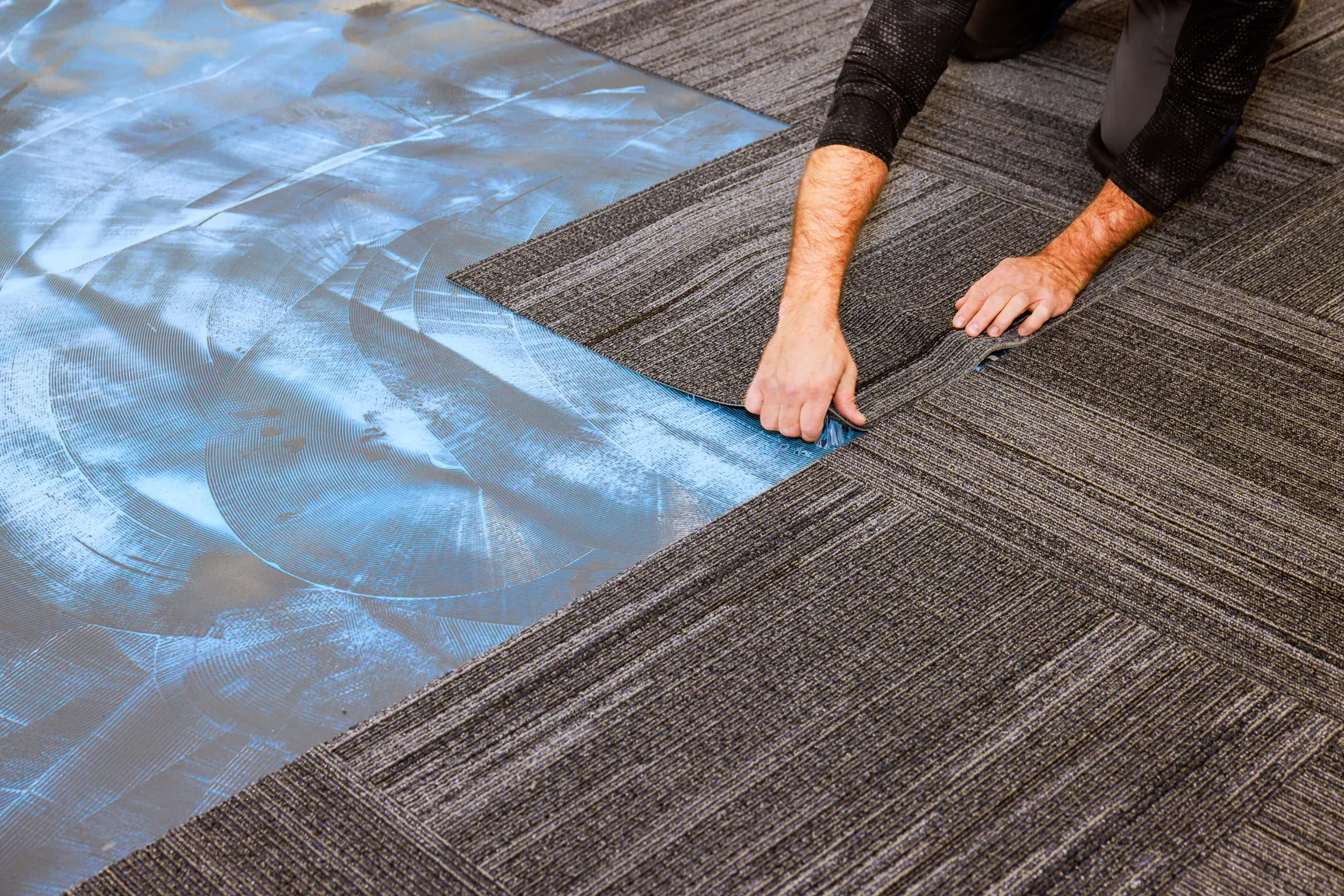
South Carolina puts flooring under two different state boards: on homes, a floor covering installer registers with the South Carolina Residential Builders Commission as a residential specialty contractor, and on commercial and other work, flooring other than carpet falls inside the Nonstructural Renovation subclassification of the general contractor license issued by the South Carolina Contractors’ Licensing Board. Around those two sit EPA’s lead-safe renovation certification, a state asbestos program that reaches floor tile, sheet vinyl and mastic, and compulsory workers’ compensation, which a flooring business secures outside the State Accident Fund, since the fund insures only public employers.
The split matters because the two halves ask for different things. The residential registration takes no exam; the commercial subclassification now does, and it applies once a job crosses the cost the statute prints. A shop that lays carpet in houses and sheet goods in offices can land on both sides of that line in the same week.
This page keeps to South Carolina’s own rules. How the policies answer a flooring claim is set out on the flooring contractor insurance page, and the service pages take each kind of firm in turn: residential flooring, commercial flooring, carpet installation and tile and stone.
South Carolina’s two routes into flooring: residential registration and the general contractor license
South Carolina reaches flooring work through two boards of the Department of Labor, Licensing and Regulation. On homes, floor covering installers are one of the residential specialty trades named in the statute, and a flooring contractor registers with the Residential Builders Commission. On other work, flooring other than carpet sits inside the Nonstructural Renovation subclassification of the general contractor license issued by the Contractors’ Licensing Board, which a firm needs once a job passes the cost threshold the statute prints.
Authority: S.C. Code Ann. §§ 40-59-20(7)(g), 40-59-220(A), 40-59-240(C); S.C. Code Regs. 106-1(g); S.C. Code Ann. §§ 40-11-30, 40-11-270(E), 40-11-410(1), 40-11-410(4)(c)
Begin with homes. The residential chapter defines the kind of contractor a flooring installer is when it works for a builder or an owner:
“"Residential specialty contractor" means an independent contractor who contracts with a licensed residential builder, general contractor, or individual property owner to do construction work, repairs, improvement, or reimprovement which requires special skills and involves the use of specialized construction trades or craft, when the undertakings exceed five hundred dollars and are not regulated by the provisions of Chapter 11.”
Among the trades that definition goes on to list, one line names the flooring installer outright:
“floor covering installers;”
And the duty that follows is registration rather than a license:
“All residential builders must be licensed, and all residential specialty contractors must be registered, by the commission for a period established by the commission in regulation.”
The Commission’s rule describes the trade broadly, and its registration page finishes the list of materials:
“Floor covering installers: the installation, replacement and repair of floor covering materials and related accessories including preparation of the surface to be covered …”
“… vinyl, rubber, linoleum, and carpet.”
Surface preparation is written into the trade itself. Two points on the registration page shape how a firm sets itself up:
“An examination is not required to become a registered specialty contractor.”
“A Residential Specialty Contractor Registration is limited to three trade classifications.”
The cap is worth planning around. A firm that also wants to register for other trades picks them together, and the statute holds it to what it picks:
“A residential specialty contractor is prohibited from undertaking work outside the scope of his license or registration, including employing, hiring, and contracting or subcontracting with others to perform such work on his behalf.”
Commercial work is governed by the general contractor chapter, which starts from a cost line:
“No entity or individual may practice as a contractor by performing or offering to perform contracting work for which the total cost of construction is greater than ten thousand dollars for general contracting or greater than ten thousand dollars for mechanical contracting without a license issued in accordance with this chapter.”
The subclassification that carries flooring is Nonstructural Renovation, and its list is where carpet drops out:
“"Nonstructural Renovation" which includes interior and exterior installing, remodeling, renovations, and finishes of acoustical ceiling systems and panels, load-bearing and nonload-bearing drywall partitions, lathing and plastering, flooring (excluding carpet) and finishing, interior recreational surfaces, window and door installation, and installation of fixtures, cabinets, and millwork;”
“the Nonstructural Renovation classification requires passing a technical exam”
A crew without that license can still work on a licensed contractor’s job, on the licensee’s terms:
“Licensees may utilize the services of unlicensed subcontractors to perform work within the limitations of the licensee's license group and license classification or subclassification; provided, the licensee provides supervision.”
A flooring firm that contracts with a homeowner, a residential builder or a general contractor on residential work registers with the Residential Builders Commission in the floor covering trade, stays inside the trades on its registration and posts the bond the Commission requires on larger jobs for an individual owner. On commercial and other work, the firm holds a general contractor license with the Nonstructural Renovation subclassification, which now takes a technical exam, or works under a licensee’s supervision as its subcontractor. County and municipal business license ordinances still apply.
“Residential specialty contractors are not exempt from complying with county and municipal business license ordinances or other regulatory ordinances.”
A split of this kind rewards a few habits:
- Mark each estimate as a home job or a commercial one at the start, since the mark decides which board’s rule applies.
- On commercial bids, set the contract price beside the cost line quoted above before you sign, not after.
- If you work under a general contractor’s license, get the supervision arrangement in the subcontract.
- Keep each county and city business license on its own renewal calendar, apart from the state filings.
Certificate requests from a general contractor are covered on the commercial flooring contractor insurance page, and homeowner questions on the residential page.
Lead paint on South Carolina flooring jobs falls to EPA on both counts
South Carolina has no lead renovation, repair and painting (RRP) program of its own. EPA administers RRP in South Carolina, so the lead-safe firm certification and renovator training a flooring contractor needs for covered work come from EPA.
Authority: 40 CFR Part 745, Subpart E; S.C. Code Ann. § 44-53-1310 et seq.
EPA lists the states that run their own renovation program, and South Carolina does not appear:
“EPA administers the RRP Program in most Tribes, states and territories, but has authorized the following to operate their own programs: Alabama, Delaware, Georgia, Iowa, Kansas, Massachusetts, Mississippi, North Carolina, Oklahoma, Oregon, Rhode Island, Utah, Vermont, Wisconsin and the Minnesota Chippewa Tribe-Boise Forte (Nette Lake).”
The abatement side is also EPA’s, and South Carolina is named on that list:
“EPA administers the Lead-Based Paint Activities Program in Alaska, Arizona, Florida, Idaho, Montana, Nevada, New Mexico, New York, South Carolina, South Dakota and Wyoming, as well as the territories of American Samoa, Guam, the Northern Mariana Islands and the U.S. Virgin Islands, and most Tribal lands.”
Painted baseboards, shoe molding, trim or door casings disturbed in older homes or child-occupied facilities bring the job under EPA’s renovation rule: the firm holds EPA lead-safe certification, a certified renovator directs or trains the crew, and lead-safe work practices apply. Lead abatement, inspection and risk assessment in South Carolina are EPA’s program too, and the state’s own lead statute is a childhood lead poisoning prevention act, not a contractor certification program.
“This article may be cited as the "Childhood Lead Poisoning Prevention and Control Act".”
A floor is rarely the painted surface, but its edges often are. Shoe molding pried off, a casing undercut to clear new plank and a painted threshold lifted are all part of getting the floor in, so the questions belong in the walkthrough:
- What year was the house built, and is that written on the estimate?
- Are painted pieces coming off, and whose hands take them off?
- Who in the firm is the certified renovator for this job?
Occupied older homes gather these questions together, and the residential flooring contractor insurance page works through them. Policy treatment of a lead claim sits on the general liability page.
South Carolina asbestos licensing and the removal method on a flooring tear-out
South Carolina’s asbestos program is the state’s own, and its reach includes floor tile, sheet vinyl and mastic removal. The Department of Environmental Services, through its Bureau of Air Quality, licenses the people and firms that remove regulated asbestos-containing material and issues a project license for each regulated renovation. Its rule counts resilient floor covering as nonfriable material until it is sanded, ground, cut, chipped, drilled or abraded, and its flooring guidance says tiles chipped up by hand or machine, and sheet flooring that has to be cut or ripped, become regulated.
Authority: S.C. Code Ann. §§ 44-87-10, 44-87-20; S.C. Code Regs. § 61-86.1, Standards of Performance for Asbestos Projects (Sections I, II, IV, VI and XV)
The statute sets the core duty for anyone doing the work:
“Asbestos abatement entities performing asbestos projects shall, before beginning work on a project, obtain an asbestos project license from the department.”
The rule then sorts materials. Resilient floor covering starts on the nonfriable side:
“Nonfriable asbestos or nonfriable asbestos-containing packing, gaskets, and resilient floor covering; …”
and moves across when the work does certain things to it:
“Category I and Category II ACM that will be or has been subjected to grinding, sanding, cutting, chipping, drilling, or abrading shall be considered regulated ACM, and the owner/operator shall comply with all applicable requirements of this regulation.”
The Asbestos Section, Bureau of Air Quality, South Carolina Department of Environmental Services applies those lines directly to flooring:
“Using destructive methods to remove asbestos-containing flooring materials cause it to become friable and therefore regulated.”
“For example asbestos-containing floor tiles that are manually or mechanically chipped from the floor are subject to the regulatory requirements for regulated asbestos-containing materials.”
“Asbestos-containing vinyl sheet flooring that must be cut or ripped during removal are also subject to the regulatory requirements for regulated asbestos-containing materials.”
“It may be possible to remove asbestos-containing floor tiles in whole pieces to avoid rendering them regulated.”
“However, chipping tiles on a flooded floor (even underwater) is a regulated activity.”
“Asbestos-containing mastic can be removed using citrus-based or petroleum-based cleaners.”
Taken together, the method is the finding. Tile lifted whole and mastic taken up with a cleaner keep a job on one side; chipping tile or cutting and ripping sheet goods puts it on the other, wet floor or not. The inspection comes ahead of all of it:
“Prior to beginning a renovation or demolition operation at any facility, the facility owner and/or owner’s representative shall ensure that an asbestos building inspection is performed to identify the presence of ACM.”
Before a renovation at a regulated facility, the owner has the affected area inspected by a licensed asbestos building inspector unless the materials are treated as asbestos. A tear-out that breaks up asbestos flooring needs a licensed asbestos contractor and a project license from the Department before work starts, while flooring taken up whole stays nonfriable but still has its own application, dust-control and landfill disposal steps. Private homes with the small number of units the rule prints are generally outside the rule unless a licensed abatement contractor does the work.
“Asbestos projects occurring at a private residential structure of four units or fewer may be exempt from the requirements of this regulation unless:”
“Performed by a person or persons holding an asbestos abatement license.”
Responsibility is shared rather than handed off:
“The facility owner and the renovation or demolition contractor are both responsible for ensuring compliance with these regulations.”
- Before pricing commercial removal, ask for the inspection report, or the owner’s decision to treat the materials as asbestos.
- Write whole-piece removal, or whatever method applies, into the proposal in plain words.
- Settle before bidding whether breaking up any tile is on the table, and who holds the license if it is.
- Tell whoever runs the tear-out to stop when an untested layer or dark adhesive turns up.
Asbestos and completed-work claims are handled on the general liability page, a general contractor’s subcontract terms on the commercial page and tile demolition on the tile and stone page.
South Carolina workers’ compensation, and the State Accident Fund that serves public employers
Employers covered by South Carolina’s Workers’ Compensation Act must carry workers’ compensation. Every covered employer must insure with an authorized insurer or group, or prove to the Workers’ Compensation Commission that it can pay benefits itself, and the Act leaves out only an employer below the employee count or payroll the statute prints; the Commission counts part-time workers and family members as employees. The State Accident Fund, which the Code establishes as a separate agency of state government, insures the State and the local governments that choose to join it, not private businesses.
Authority: S.C. Code Ann. §§ 42-1-310, 42-1-360(2), 42-1-410, 42-5-20(A)(1), 42-5-40, 42-5-45; S.C. Code Ann. §§ 42-7-10(A), 42-7-40, 42-7-50
The Act works by presumption:
“Every employer and employee, except as stated in this chapter, shall be presumed to have accepted the provisions of this title respectively to pay and accept compensation for personal injury or death by accident arising out of and in the course of the employment and shall be bound thereby.”
Its exceptions include a small-employer line:
“This title does not apply to:”
“any person who has regularly employed in service less than four employees in the same business within the State or who had a total annual payroll during the previous calendar year of less than three thousand dollars regardless of the number of persons employed during that period”
“Part-time workers and family members are counted as employees”
An employer inside the Act then has to secure the coverage:
“Every employer who accepts the provisions of this title relative to the payment of compensation shall insure and keep insured his liability thereunder in any authorized corporation, association, organization, or mutual insurance association formed by a group of employers so authorized or shall furnish to the commission satisfactory proof of his financial ability to pay directly the compensation in the amount and manner and when due as provided for in this title.”
“Workers’ compensation insurance coverage can be obtained via a commercial insurance carrier licensed to write workers’ compensation insurance coverage in the state of South Carolina or via the state’s assigned risk program …”
A flooring subcontractor below the employee count can still be asked for its own policy: the Act makes a contractor liable for compensation to its subcontractor’s workers, and the Commission says a general contractor may require coverage from its subcontractors for that reason. An employer that must insure and fails to is fined and loses its common-law defenses in an employee’s lawsuit, and a willful refusal is a misdemeanor.
“Employees of a subcontractor are statutory employees of a general contractor.”
“A general contractor may require their subcontractors to maintain workers’ compensation insurance to work on their jobs in order to avoid the liability of a workers’ compensation claim from an uninsured employer/subcontractor.”
“and in any such action such employer shall not be permitted to defend upon any of the grounds mentioned in Section 42-1-510.”
“Any employer required to secure payment of compensation under this title who wilfully refuses to secure such compensation shall be guilty of a misdemeanor …”
The State Accident Fund is a state agency set up by its own article of the Code:
“There is established as a separate agency of state government a separate fund to be known as the State Accident Fund, hereinafter referred to as the "fund" or "state fund" in this article.”
“The South Carolina State Accident Fund was established in 1943 for the purpose of providing workers' compensation coverage and administration for all state agencies and other local governmental entities at reasonable prices.”
Its role, in the record’s words: the state fund for workers’ compensation, a separate agency of state government that insures the State and the counties, municipalities and public agencies that elect to participate; it does not write private employers. For a flooring employer, then, the choice is among the routes the Commission lists, and how payroll, family members and installers paid as subcontractors are treated in a placement is the business of the workers’ compensation page.
South Carolina offices behind the rules a flooring firm meets
The South Carolina Department of Insurance is the state’s insurance regulator. Anyone can check our agency’s license, as with any agency, on NIPR.com.
Every other office cited on this page appears below with the role the record verified:
- South Carolina Residential Builders Commission: registers residential specialty contractors, including floor covering installers, and licenses residential builders
- South Carolina Contractors’ Licensing Board: licenses general and mechanical contractors, including the Nonstructural Renovation subclassification that covers flooring other than carpet
- South Carolina Department of Environmental Services: state environmental agency that runs the asbestos licensing and project licensing program
- Asbestos Section, Bureau of Air Quality, South Carolina Department of Environmental Services: asbestos permits for regulated renovation and demolition, and licensing of the people who inspect, design, monitor, remove or otherwise handle regulated asbestos-containing material
- U.S. Environmental Protection Agency: administers the renovation, repair and painting program and the lead abatement program in South Carolina; no state lead-based paint program exists
- South Carolina Workers’ Compensation Commission: workers’ compensation administration, coverage verification, enforcement against uninsured employers and self-insurance approval
South Carolina’s flooring markets and their counties
South Carolina’s largest metropolitan areas appear below, each listed with the counties it takes in on the South Carolina side, as delineated by the federal Census Bureau. The licensing line is the same on every card because both boards and the local business license duty reach the whole state.
Charlotte-Concord-Gastonia, NC-SC
South Carolina side: Chester County, Lancaster County and York County.
Home flooring jobs here run on the state registration, commercial jobs past the statute’s cost line on the state general contractor license, and county and city business licenses apply to both.
Greenville-Anderson-Greer, SC
South Carolina counties: Anderson County, Greenville County, Laurens County and Pickens County.
Home flooring jobs here run on the state registration, commercial jobs past the statute’s cost line on the state general contractor license, and county and city business licenses apply to both.
Charleston-North Charleston, SC
South Carolina counties: Berkeley County, Charleston County and Dorchester County.
Home flooring jobs here run on the state registration, commercial jobs past the statute’s cost line on the state general contractor license, and county and city business licenses apply to both.
Columbia, SC
South Carolina counties: Calhoun County, Fairfield County, Kershaw County, Lexington County, Richland County and Saluda County.
Home flooring jobs here run on the state registration, commercial jobs past the statute’s cost line on the state general contractor license, and county and city business licenses apply to both.
Myrtle Beach-Conway-North Myrtle Beach, SC
South Carolina counties: Horry County.
Home flooring jobs here run on the state registration, commercial jobs past the statute’s cost line on the state general contractor license, and county and city business licenses apply to both.
Spartanburg, SC
South Carolina counties: Spartanburg County and Union County.
Home flooring jobs here run on the state registration, commercial jobs past the statute’s cost line on the state general contractor license, and county and city business licenses apply to both.
Coverage pages that fit South Carolina flooring work
Once the state rules are placed, the policies are the ones a flooring business carries anywhere, each with its own page:
- Injury and damage to others, tear-out and finished floors: general liability.
- Your crew, and installers you pay as subcontractors: workers’ compensation.
- Stretchers, saws, sanders and stock carried between jobs: inland marine for contractors’ tools and equipment.
What you lay, and for whom, sets the weight of each. A registered residential shop, a licensed commercial firm, a carpet installation company outside the commercial subclassification and a tile and stone setter meet different owners and different tear-outs, and the service pages take them one at a time. When your South Carolina picture is sorted, ask us for a quote.
Residential Flooring Contractor Insurance
A panel for South Carolina in rows. Contractor license: a state license or registration can reach this work. It connects to the General Liability page. Lead-safe renovation: the federal program applies in this state. It connects to the Residential Flooring Contractor Insurance page. Asbestos flooring and mastic: a state program reaches flooring removal. It connects to the General Liability page. Workers’ compensation: open market or the state fund. It connects to the Workers Compensation page. Each row pairs a state rule with the page on this site that discusses it. No figures are shown.
Nearby states we also write
Related coverage and services
What we insure
Outside authorities
- South Carolina Department of Insurance
- South Carolina Residential Builders Commission
- South Carolina Contractors’ Licensing Board
- South Carolina Department of Environmental Services
- Asbestos Section, Bureau of Air Quality, South Carolina Department of Environmental Services
- South Carolina Workers’ Compensation Commission
- U.S. Environmental Protection Agency
- State Accident Fund
South Carolina flooring contractor insurance questions
Does a South Carolina floor covering installer register, or get a license?
For home work, it registers. Floor covering installers are one of the residential specialty trades the statute names, every residential specialty contractor must register with the South Carolina Residential Builders Commission, and the Commission says no examination is required. A registered firm stays inside the trades on its registration, and county and municipal business license ordinances still apply.
Which South Carolina license reaches commercial flooring, and is carpet part of it?
On work outside the residential chapter, a job above the cost of construction the statute prints needs a license from the South Carolina Contractors’ Licensing Board. Flooring sits inside the Nonstructural Renovation subclassification of the general contractor license, and the statute excludes carpet from that subclassification by name. The board now requires a technical exam for Nonstructural Renovation.
Can an unlicensed flooring crew work under a South Carolina general contractor on a commercial job?
The general contractor chapter lets a licensee use unlicensed subcontractors for work within its own license group and classification or subclassification, provided the licensee supervises the work. The license and the supervision are the licensee’s, not the crew’s.
Where does a South Carolina flooring firm get certified for work that disturbs lead paint?
From EPA. South Carolina is not on EPA’s list of states authorized to run their own renovation program, and EPA also administers the lead abatement program in the state. The state’s lead statute is a childhood lead poisoning prevention act, not a contractor certification program.
When does pulling up old floor tile in South Carolina turn into a licensed asbestos project?
When the removal breaks it up. The state rule counts resilient floor covering as nonfriable until it is sanded, ground, cut, chipped, drilled or abraded, and the South Carolina Department of Environmental Services says tiles chipped up by hand or machine, and sheet flooring that has to be cut or ripped, are regulated. Regulated removal needs a licensed asbestos contractor and a project license before work starts; flooring taken up whole stays nonfriable but still has its own application, dust-control and disposal steps.
Is a floor replacement in a South Carolina house inside the asbestos rule?
Generally not. The rule exempts projects at private residential structures up to the unit count it prints, and the Department says work at private residences is not regulated unless a licensed asbestos abatement contractor does it.
Can a South Carolina flooring company insure its crew through the State Accident Fund?
No. The State Accident Fund is a separate agency of state government that insures the State and the counties, municipalities and public agencies that elect to participate; it does not write private employers. The South Carolina Workers’ Compensation Commission names the routes open to a business: a commercial insurer licensed to write the coverage in South Carolina, or the state’s assigned risk program. An employer may instead prove to the Commission that it can pay benefits itself.
Which South Carolina office is the insurance regulator?
The South Carolina Department of Insurance. The workers’ compensation statute also requires its director’s approval of policy forms, while the South Carolina Workers’ Compensation Commission administers the workers’ compensation system itself.
This page describes insurance for flooring contractors and installers operating in this state. It is general information, not legal advice and not a statement of coverage. Licensing, lead-safe and asbestos requirements change; verify current requirements with the agency named before relying on them.
Get a quote for your South Carolina flooring work
Tell us how your South Carolina jobs divide between houses and commercial buildings, what comes up before the new floor goes down and who is on the payroll, and we will shape the program to fit.