
Flooring Contractor Insurance by State
New York Flooring Contractor Insurance
New York issues no flooring license, yet its asbestos law names the tile, adhesive and mastic a crew lifts, and workers’ compensation can come from a fund of the state or a private insurer.
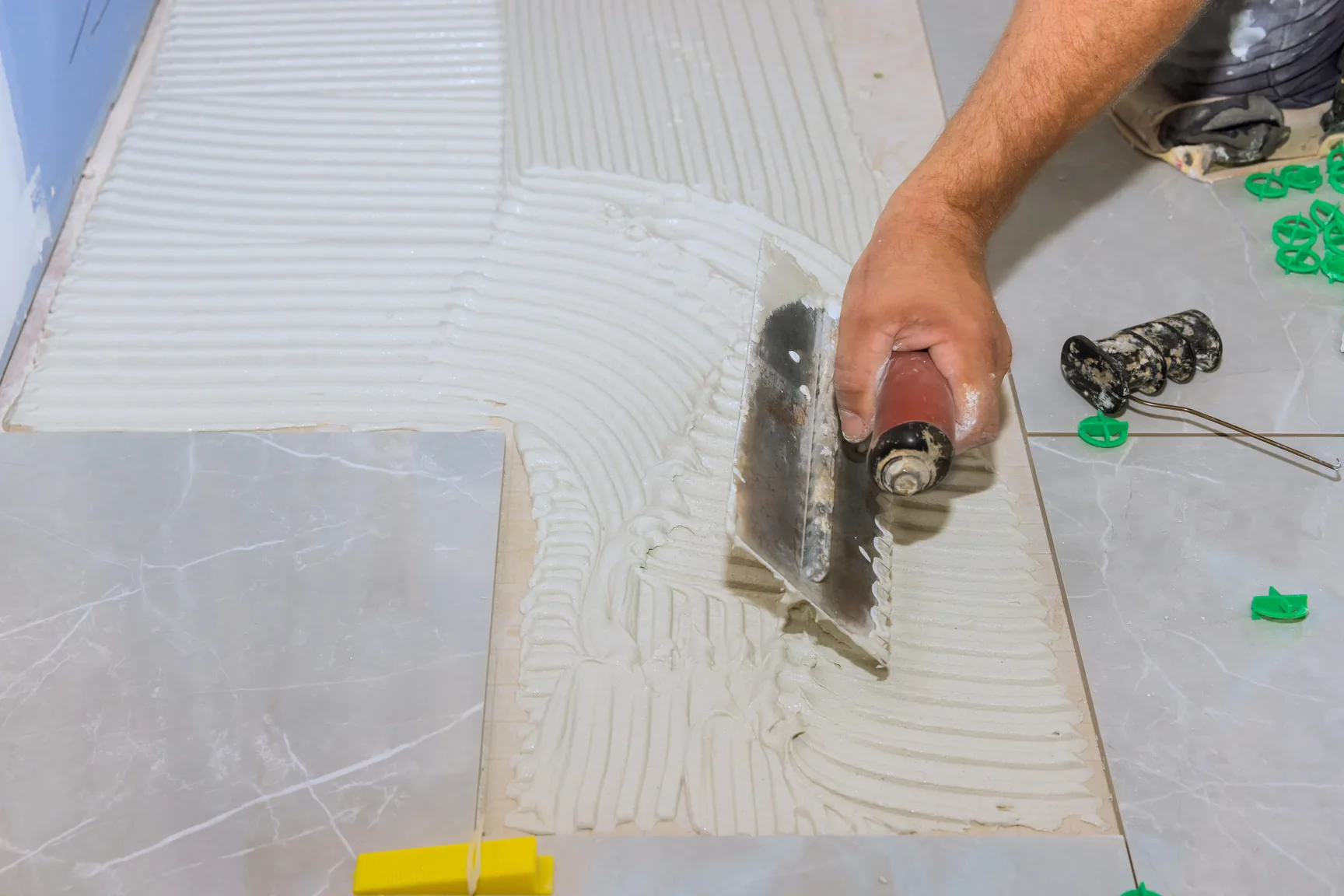
Before a New York flooring crew lifts old resilient tile or the mastic under it, the state’s asbestos law has already spoken: the Labor Law counts flooring materials, adhesives and mastics as asbestos material, a contractor needs the asbestos handling license the New York State Department of Labor, Asbestos Control Bureau issues to remove them, and the Department’s own rule calls for an owner’s asbestos survey before the renovation and sets a procedure just for flooring and mastic removal. Workers’ compensation is compulsory, and the New York State Insurance Fund, a fund of the state, writes it alongside private insurers, while contractor licensing is local and lead-safe renovation certification comes from EPA.
Every rule a flooring business meets here has an address, and in New York the address changes with the subject. The trade itself carries no state license. The home improvement contract does have a state statute, and flooring is written into it. Lead-safe renovation sits with a federal agency. Asbestos sits with a state department whose rule names the materials a crew pulls up. Workers’ compensation can be bought from a fund of the state as well as from the private market. The sections below print each verified finding, quote its source, and then turn to what it changes on a job.
Each policy is explained on the flooring contractor insurance page and on the service pages for residential flooring, commercial flooring, carpet installation and tile and stone work. Here the subject is narrower: the New York rules those policies sit beside.
New York’s home improvement law names flooring, while the license itself stays local
New York issues no statewide contractor license for flooring work, and no general or home improvement contractor license. The Department of State’s Division of Licensing Services licenses occupations from barbers to home inspectors and security alarm installers, with no general, home improvement or flooring contractor among them. State law instead governs the home improvement contract itself, and it names flooring in its definition of home improvement.
Authority: N.Y. Gen. Bus. Law §§ 770(3), 770(3)(d), 770(6), 771(1), 771(1)(a)
The finding has two halves that a flooring owner should keep apart. Licensing of the trade is absent at state level, while the paper a home job runs on is regulated by statute. The statute’s definition is the reason flooring belongs in that conversation at all:
““Home improvement” means the repairing, remodeling, altering, converting, or modernizing of, or adding to, residential property and shall include, but not be limited to, the construction, erection, replacement, or improvement of driveways, swimming pools, siding, insulation, roofing, windows, terraces, patios, landscaping, fences, porches, garages, solar energy systems, flooring, basements, and other improvements of the residential property and all structures or land adjacent to it.”
Flooring sits in that list by name, between solar energy systems and basements. The same section then takes certain work back out, and one of its exclusions speaks directly to carpet installers:
“the sale or installation of decorative goods or services, such as draperies and carpets”
A carpet job and a tile or hardwood job in the same house can therefore land on different sides of the definition. Where the line falls on a mixed job, with carpet upstairs and plank in the kitchen, is a question for the contract and, when it matters, for your lawyer; the two passages above are the words it turns on.
The missing state license does not leave a New York flooring business with nothing to do. A flooring contractor working on a home puts every home improvement contract above the price set in the statute in a writing signed by both sides, with the contractor’s name, address, telephone number and any license number, and the statute’s other terms, though it leaves decorative goods and services such as carpets out of its definition. Licensing is set locally: New York City and the counties of Suffolk, Nassau, Westchester, Putnam and Rockland license home improvement contractors, so the rule for a particular job is set where the work is done.
“Every home improvement contract subject to the provisions of this article, and all amendments thereto, shall be evidenced by a writing and shall be signed by all the parties to the contract.”
“The name, address, telephone number and license number, if applicable, of the contractor.”
Both passages are easy to build into an office routine. Print the contractor details at the head of every home proposal in the order the statute lists them, so the document you hand the homeowner is already the writing the law describes. Treat a change order as an amendment on paper rather than a hallway conversation, since the statute reaches amendments in the same breath as the contract.
The license itself is issued below the state. A fact sheet from the Suffolk County Department of Labor, Licensing and Consumer Affairs sets out where:
“Home improvement contractors must be licensed in New York City, Suffolk, Nassau, Westchester, Putnam, and Rockland counties.”
If your crews work in those places, put the local license on the bid checklist next to the written contract. Anywhere else, call the city or county office during the bid and ask what it requires of a contractor doing the work you are quoting. Proof you are insured, the certificate a general contractor or a homeowner asks to see, is another document again, taken up on the commercial flooring contractor insurance and residential pages.
Baseboards, thresholds and the federal lead rule on New York flooring jobs
Certification of lead-safe renovation firms is not a state function in New York. New York is not among the states EPA has authorized to run their own renovation, repair and painting (RRP) program, so EPA administers the rule there directly, and a flooring company that disturbs paint on covered work holds its firm certification from EPA.
Authority: 40 CFR Part 745
Under EPA’s rule, a crew that removes painted baseboards, shoe molding, thresholds or door casings in covered housing or a child-occupied facility is doing renovation work: the firm is certified by EPA, its workers are trained by or as certified renovators, and the rule’s work practices apply, with the building-age threshold quoted below as printed. EPA also keeps lead abatement, inspection and risk assessment in New York, so no state lead license stands in for the federal one.
EPA’s own list of authorized programs settles who runs renovation certification, and New York is not on it:
“EPA administers the RRP Program in most Tribes, states and territories, but has authorized the following to operate their own programs: Alabama, Delaware, Georgia, Iowa, Kansas, Massachusetts, Mississippi, North Carolina, Oklahoma, Oregon, Rhode Island, Utah, Vermont, Wisconsin and the Minnesota Chippewa Tribe-Boise Forte (Nette Lake).”
The requirement reaches every paid firm that disturbs paint in the buildings it describes, and the age line it draws is the question to ask at the walkthrough:
“In general, anyone paid to perform work that disturbs paint in housing and child-occupied facilities built before 1978 must be certified in lead-safe work practices. This includes all firms, even sole proprietorships.”
Nor does the state run the abatement side. EPA names New York among the places where it keeps lead-based paint activities in its own hands:
“EPA administers the Lead-Based Paint Activities Program in Alaska, Arizona, Florida, Idaho, Montana, Nevada, New Mexico, New York, South Carolina, South Dakota and Wyoming”
One certificate system, federal, therefore covers both the firm and the renovators on the crew. The trim is where it surfaces. The pieces the obligation sentence names are the ones that come off before a new floor goes down and go back on after it, so decide before the job starts who removes them, and confirm that whoever does works for a certified firm. Liability policies and lead claims meet on the general liability page; older homes as a whole are a subject of the residential page.
New York’s asbestos handling license and the floor tile and mastic a crew lifts
New York’s asbestos law reaches flooring removal by name. The Labor Law makes any removal or disturbance of friable or non-friable asbestos an asbestos project, counts flooring materials, adhesives and mastics among non-friable asbestos materials, and makes it unlawful for any contractor to engage in an asbestos project without a Department of Labor asbestos handling license. The department’s Industrial Code Rule sets a dedicated procedure for removing non-friable asbestos flooring and mastic.
Authority: N.Y. Labor Law §§ 901(7), 901(14), 902(1); 12 NYCRR §§ 56-1.3, 56-2.1, 56-5.1(a), 56-11.7
The statute begins with what counts as an asbestos project, and the definition is wide:
““Asbestos project” means work undertaken which involves the removal, encapsulation, enclosure, repair or disturbance of friable or non-friable asbestos, or any handling of asbestos material that may result in the release of asbestos fiber except for work in an owner-occupied single family dwelling performed by the owner of such dwelling”
It then says what counts as asbestos material, and the flooring trade’s own products are in the list:
““Non-friable organically bound (NOB) asbestos material” means a wide range of non-friable asbestos materials embedded in flexible-to-rigid … vinyl matrices, including but not limited to, flooring materials, adhesives, mastics, …”
And it says who may do the work:
“It shall be unlawful for any contractor to engage in an asbestos project unless such contractor has a valid asbestos handling license issued by the commissioner.”
Read in sequence, those provisions describe an ordinary tear-out. A crew removing asbestos-containing tile or mastic is engaged in an asbestos project, and a contractor without the handling license may not do it. The one carve-out in the definition belongs to an owner working on the owner’s own single-family home, which a flooring business hired by someone else is not. The licensing and enforcement sit with the New York State Department of Labor, Asbestos Control Bureau.
The Department’s Industrial Code Rule, as published by the Department, adds two things an estimator needs. The first is the survey that comes before the work:
“An owner or an owner’s agent, except the owner of one and two-family dwellings who contracts for, but does not direct or control the work, shall cause to be conducted, an asbestos survey completed by a licensed asbestos contractor using inspectors certified in compliance with Section 56-3.2(d), to determine whether or not the building or structure, or portion(s) thereof to be demolished, renovated, remodeled, or have repair work, contains ACM, PACM or asbestos material.”
The rule lists exemptions from that survey; one of them turns on when a building went up:
“buildings or struc tures for which original construction commenced on or after January 1, 1974”
The second is a removal procedure with a section of its own:
“Non-friable Flooring and/or Mastic Removal. The following Phase II abatement procedures shall apply for removal of non-friable asbestos-containing … flooring and/or mastic materials including cove base and associated mastic.”
Before tearing out resilient tile, sheet flooring, cove base or mastic in an older building, the owner or the owner’s agent has an asbestos survey done by a licensed asbestos contractor using certified inspectors, unless an exemption applies, such as a building whose original construction began on or after the date quoted below. If the flooring or mastic contains asbestos, its removal is an asbestos project: it goes to a contractor holding the department’s asbestos handling license, with certified workers, under the rule’s flooring and mastic procedure. Only an owner working on the owner’s own single-family home falls outside the law. In New York City, asbestos work practices are also governed by the city’s own rules.
On the job, the order of operations runs survey, then decision, then bid. Should the survey find asbestos in the tile or the mastic, the removal belongs to a contractor holding the handling license, and a crew without one starts after that work is done. A crew should never be the first to learn what lies under the floor it was hired to replace. New York City adds a further layer, which the Department’s own guidance flags:
“Most asbestos handling in New York City, including abatement and transportation, is governed by New York City rules and regulations.”
- Ask for the survey with the bid documents on any building old enough to need one, and read what it says about the floor you are quoting.
- Say in the proposal who removes any asbestos-containing flooring the survey finds, and what happens to the schedule if it does.
- If a second layer of old flooring turns up under the first, stop and call the owner before anyone scrapes it.
Tear-out claims involving asbestos belong to the policy, and the question is worked through on the general liability page. Commercial tear-outs bring the general contractor’s contract terms too, covered on the commercial page, and tile demolition raises its own version of the question on the tile and stone page.
Three ways to secure New York workers’ compensation, the New York State Insurance Fund among them
New York makes workers’ compensation compulsory: every employer subject to the Workers’ Compensation Law secures compensation for its employees, by insuring with the State Insurance Fund, by insuring with a stock, mutual or reciprocal insurer authorized to write the coverage in New York, or by qualifying with the Workers’ Compensation Board to self-insure. The State Insurance Fund is a fund of the state, continued in the Department of Labor, and it writes the coverage alongside private insurers.
Authority: N.Y. Workers’ Comp. Law §§ 2(2), 2(12), 10(1), 50, 52(1)(a), 57(1), 76(1), 77, 85
The statute sets out the ways in a list, and the first two entries are the ones most flooring employers weigh:
“An employer shall secure compensation to his employees in one or more of the following ways:”
“By insuring and keeping insured the payment of such compensation in the state fund, or”
“By insuring and keeping insured the payment of such compensation with any stock corporation, mutual corporation or reciprocal insurer authorized to transact the business of workers' compensation insurance in this state through a policy issued under the law of this state.”
The New York State Insurance Fund is the state fund that first entry refers to, and its statute constitutes it in these words:
“There is hereby continued in the department of labor a fund known as “the state insurance fund”, for the purpose of insuring employers against liability for personal injuries or death sustained by their employees”
The Board adds what the fund’s duty means for an employer looking for coverage:
“NYSIF must provide insurance to any employer seeking coverage, regardless of the employer’s type of business, safety record or size.”
From the first employee in most cases, a New York flooring contractor carries workers’ compensation, through a private insurer, the State Insurance Fund, which must insure any employer that seeks coverage unless it owes the fund money, or self-insurance. State and municipal offices may not issue a permit or sign a contract for work in a hazardous employment without proof of coverage, and failing to secure coverage is a crime whose grade and fines rise with the number of employees, as quoted below.
“WCL §57 requires the heads of all municipal and State entities to ensure that businesses applying for permits, licenses or contracts have appropriate workers’ compensation insurance coverage.”
“Failure to secure the payment of compensation for five or less employees within a twelve month period shall constitute a misdemeanor, and is punishable by a fine of not less than one thousand nor more than five thousand dollars. Failure to secure the payment of compensation for more than five employees within a twelve month period shall constitute a class E felony, and is punishable by a fine of not less than five thousand dollars nor more than fifty thousand dollars in addition to any other penalties otherwise provided by law.”
The choice in New York is a real one: a private insurer authorized to write the coverage, the fund, or self-insurance approved by the New York State Workers’ Compensation Board. Which suits a given flooring business, and how an underwriter looks at its payroll and at installers it pays as subcontractors, are placement questions for the workers’ compensation page.
New York’s insurance regulator and the other bodies named on this page
The New York State Department of Financial Services regulates insurance in New York and authorizes the private insurers that write workers’ compensation and general liability there. Our license as an insurance agency is public: look it up on NIPR.com, as you can for any agency.
Each of the other offices holds one piece of the picture, described as the record verified it:
- New York State Department of State, Division of Licensing Services: the state’s occupational licensing division; its list of license types carries no general, home improvement or flooring contractor license
- New York State Department of Labor, Asbestos Control Bureau: licenses asbestos contractors, certifies asbestos workers, receives project notifications and enforces the Labor Law and the department’s asbestos Industrial Code Rule statewide
- New York State Workers’ Compensation Board: administers the Workers’ Compensation Law: coverage compliance and penalties, self-insurance and claims
As the lead section explains, lead-safe renovation and lead-based paint activities stay with the U.S. Environmental Protection Agency. No statewide contractor board appears among them, for the reason the licensing section gives. The home improvement licenses that do exist come from the city and counties that section names, and the state fund is described with workers’ compensation above.
The New York metros on the Census list, and the counties each one covers
Every card below names one of the largest metropolitan areas with a principal city in New York, as the U.S. Census Bureau delineates them. On a metro that crosses a state line, only the New York counties are listed.
New York-Newark-Jersey City, NY-NJ
New York counties in this metro: Nassau County, Suffolk County, Bronx County, Kings County, New York County, Putnam County, Queens County, Richmond County, Rockland County and Westchester County.
No state contractor license applies here. The state’s home improvement contract rules govern home jobs, and any local license is set where the job sits, so check with the city or county before you bid.
Buffalo-Cheektowaga, NY
Counties in this metro: Erie County and Niagara County.
No state contractor license applies here. The state’s home improvement contract rules govern home jobs, and any local license is set where the job sits, so check with the city or county before you bid.
Rochester, NY
Counties in this metro: Livingston County, Monroe County, Ontario County, Orleans County and Wayne County.
No state contractor license applies here. The state’s home improvement contract rules govern home jobs, and any local license is set where the job sits, so check with the city or county before you bid.
Albany-Schenectady-Troy, NY
Counties in this metro: Albany County, Rensselaer County, Saratoga County, Schenectady County and Schoharie County.
No state contractor license applies here. The state’s home improvement contract rules govern home jobs, and any local license is set where the job sits, so check with the city or county before you bid.
Kiryas Joel-Poughkeepsie-Newburgh, NY
Counties in this metro: Dutchess County and Orange County.
No state contractor license applies here. The state’s home improvement contract rules govern home jobs, and any local license is set where the job sits, so check with the city or county before you bid.
Syracuse, NY
Counties in this metro: Madison County, Onondaga County and Oswego County.
No state contractor license applies here. The state’s home improvement contract rules govern home jobs, and any local license is set where the job sits, so check with the city or county before you bid.
Coverage pages for the New York work described above
The findings above say where the rules sit. Answering for the work itself takes the same set of policies a flooring business carries in any state, each with its own page:
- General liability: the page on injury and damage to others, finished work and tear-out.
- Workers’ compensation: the page on the crew and on subcontracted installers.
- Tools and equipment coverage (inland marine): the page on the saws, trowels, sanders and material that move between jobs.
Between carpet installers and tile and stone shops, the owners, the floors and the tear-outs differ in New York, and their service pages treat each on its own terms. Request a quote when you know which pieces your New York work needs, and we will put them together.
Residential Flooring Contractor Insurance
A panel for New York in rows. Contractor license: no statewide license reaches this work. It connects to the General Liability page. Lead-safe renovation: the federal program applies in this state. It connects to the Residential Flooring Contractor Insurance page. Asbestos flooring and mastic: a state program reaches flooring removal. It connects to the General Liability page. Workers’ compensation: open market or the state fund. It connects to the Workers Compensation page. Each row pairs a state rule with the page on this site that discusses it. No figures are shown.
Nearby states we also write
Related coverage and services
What we insure
New York flooring contractor insurance questions
Is there a New York State license for a flooring installer?
No. The New York State Department of State, Division of Licensing Services keeps a list of license types with no general, home improvement or flooring contractor on it. Home improvement contractors are licensed locally instead, by New York City and by the counties of Suffolk, Nassau, Westchester, Putnam and Rockland, so the rule for a job is set where the work is done.
Does New York’s home improvement contract law reach a carpet job?
The General Business Law names flooring in its definition of home improvement, but it leaves out the sale or installation of decorative goods or services, such as draperies and carpets. A hardwood, tile or plank job in a home sits inside the definition; carpet is named among the exclusions.
Where does a New York flooring firm get its lead-safe renovation certification?
From EPA. New York is not among the states EPA has authorized to run their own renovation program, and EPA also administers lead abatement, inspection and risk assessment there, so no state lead license stands in for the federal one.
Can my crew pull up old asbestos floor tile or mastic in New York?
Only as a contractor holding the asbestos handling license the New York State Department of Labor, Asbestos Control Bureau issues, with certified workers, under the rule’s procedure for non-friable flooring and mastic. The Labor Law counts flooring materials, adhesives and mastics as asbestos material and makes their removal or disturbance an asbestos project; the one carve-out is an owner working on the owner’s own single-family home.
Who has the asbestos survey done before a New York renovation?
The owner or the owner’s agent, through a licensed asbestos contractor using certified inspectors, unless an exemption applies, such as a building whose original construction began on or after the date the rule sets. Ask for the survey before you price a tear-out.
Does New York sell workers’ compensation through a fund of its own?
Yes. The New York State Insurance Fund is a fund of the state, continued in the Department of Labor, and it writes the coverage alongside private insurers; the New York State Workers’ Compensation Board says it must provide insurance to any employer seeking coverage. An employer may instead insure with a stock, mutual or reciprocal insurer authorized to write the coverage in New York, or qualify with the Board to self-insure.
Which New York office oversees the insurers that write flooring coverage?
The New York State Department of Financial Services, which authorizes the private insurers that write workers’ compensation and general liability in New York. The New York State Workers’ Compensation Board administers the Workers’ Compensation Law itself, including coverage compliance, penalties and self-insurance.
This page describes insurance for flooring contractors and installers operating in this state. It is general information, not legal advice and not a statement of coverage. Licensing, lead-safe and asbestos requirements change; verify current requirements with the agency named before relying on them.
Get a quote for your New York flooring work
Send us the New York counties your crews cover, the age of the buildings you work in and how your payroll is split, and we will shape a program around those answers.