
Flooring Contractor Insurance by State
New Jersey Flooring Contractor Insurance
New Jersey registers home improvement businesses rather than licensing the flooring trade, and the licensing law it has passed is still waiting on its board’s rules.
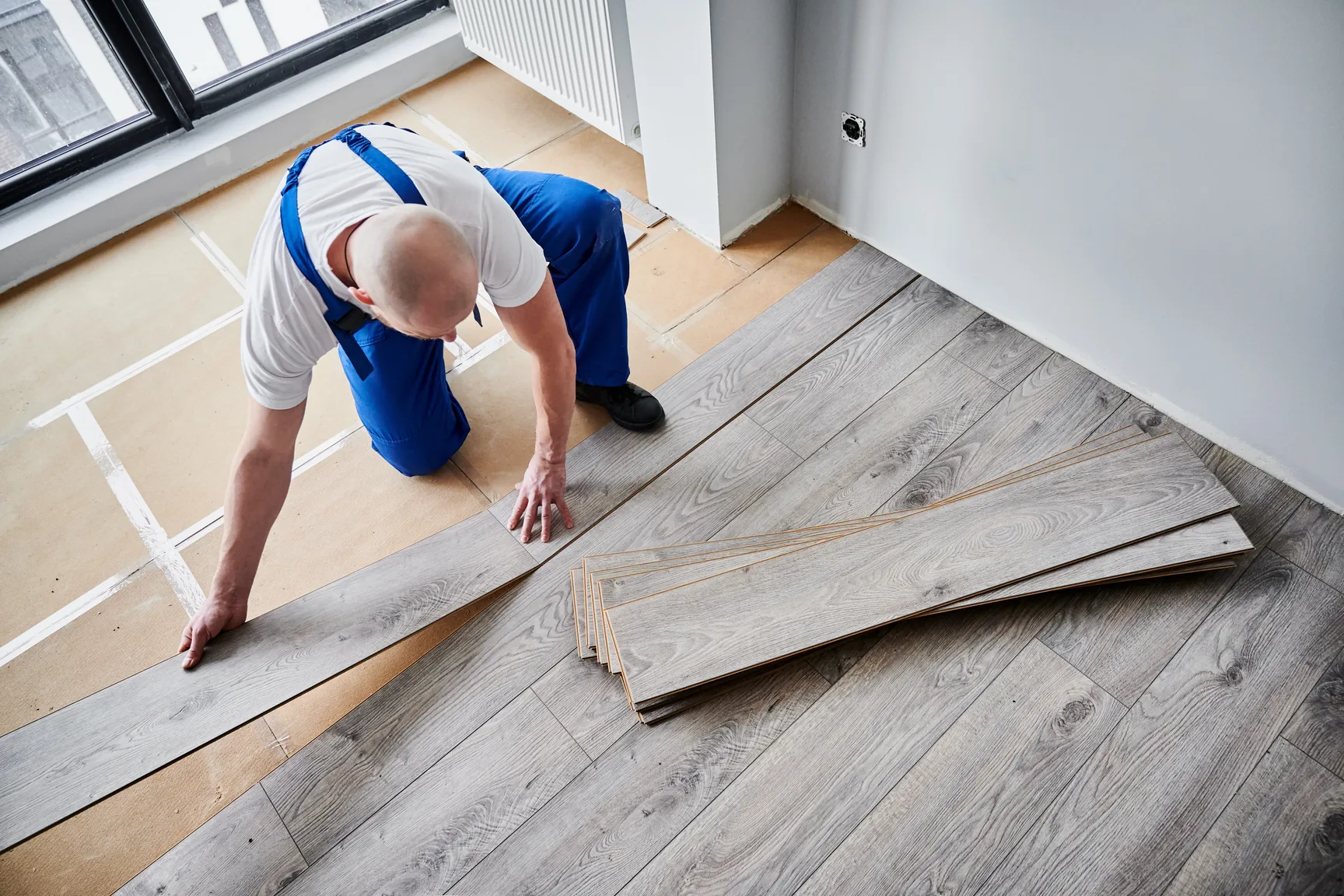
New Jersey expects a flooring business that works on homes to register every year with the New Jersey Division of Consumer Affairs before it offers or does the work, and to file proof of commercial general liability insurance, and of workers’ compensation unless the law exempts it, with that registration; flooring work on commercial property sits outside it. A newer law creates a state board that may license carpeting and flooring as a specialty, but that licensing duty is not in force: it stays inoperative until a set period after the board adopts its rules.
Around that registration, lead-safe renovation certification comes from EPA, the state’s own asbestos license reaches the removal of old floor tile, and workers’ compensation is compulsory and comes from the private market, because New Jersey has no state fund. The home side of the trade is already answered at the state level, and the trade license the state has written is not yet switched on, so an owner here tracks one filing that exists and one that is still to come.
Each finding below is printed as verified, beside its source’s words and a note for an owner who bids and staffs crews. For how the policies respond to a flooring claim, see the flooring contractor insurance page and the pages it links to, whether you run a residential flooring crew in occupied homes, a commercial flooring firm working for general contractors, a carpet installation company or a tile and stone shop.
New Jersey’s home improvement registration, and a flooring license still waiting to start
New Jersey has no state trade license for flooring work in force today, but a business that sells or performs home improvements must register every year with the Division of Consumer Affairs before it offers or does the work. The registration law defines home improvement as work on any part of a residential property, so it reaches floors in homes and apartments without naming flooring; commercial flooring work is outside it. A newer licensing law creates a state board that may issue limited specialty licenses in carpeting and flooring, but its duty to hold a license stays inoperative until a set period after the board adopts its rules.
Authority: N.J.S.A. 56:8-136 et seq., 56:8-137, 56:8-138(a), 56:8-142(a), (e), 56:8-148 (Contractors’ Business Registration Act); N.J.S.A. 45:5AAA-1 et seq., 45:5AAA-5(b), 45:5AAA-6(j), 45:5AAA-9 (Home Improvement and Home Elevation Contractor Licensing Act)
Two laws sit behind that finding, and only one of them binds a flooring business today. The one that binds is a registration, and it is written as a bar on doing business at all without it:
“No contractor business shall offer to perform, or engage, or attempt to engage in the business of making or selling home improvements unless registered with the Division of Consumer Affairs in accordance with the provisions of P.L.2004, c.16 (C.56:8-136 et seq.).”
Offering the work is enough to fall inside it, so the registration comes before any advertising for home installation. Its reach comes from the definition of home improvement:
“"Home improvement" means the remodeling, altering, renovating, repairing, restoring, modernizing, moving, demolishing, or otherwise improving or modifying of the whole or any part of any residential property.”
Flooring is not listed by name, and it does not need to be. Replacing a floor is repairing, renovating or improving part of a residence, which puts carpet, plank, sheet goods and tile in a home or an apartment on the same side of the line.
A flooring business working on residential property registers with the Division of Consumer Affairs, files proof of commercial general liability insurance at the level the statute sets and of workers’ compensation insurance unless the law exempts it, and keeps a compliance bond or equivalent security in force for the whole registration period. Commercial flooring work falls outside the registration, and the law leaves each municipality its power to inspect and set standards for a contractor’s work on commercial property.
That sentence is where the registration turns into an insurance matter. The proof a registered business files with the state is set out in the statute’s own terms:
“… every registered contractor business who is engaged in home improvements shall secure, maintain and file with the director proof of a certificate of commercial general liability insurance in a minimum amount of $500,000 per occurrence and workers' compensation insurance unless exempted by law.”
Read that as the floor the registration asks you to show, not as a recommendation for a flooring program. The general liability page explains what that kind of policy responds to on a flooring job, and the workers’ compensation half comes up again further down this page.
Commercial jobs sit on the other side of the line. The statute does not stretch the registration to them, and it says in so many words that local government keeps its hand on that work:
“P.L.2004, c.16 (C.56:8-136 et seq.) shall not deny to any municipality the power to inspect a contractor business' work or equipment, the work of a contractor business that performs improvements to commercial property, or the power to regulate the standards and manners in which the contractor business' work shall be done.”
The licensing law that is not yet in force
The second law is the one that names the trade. It creates the New Jersey State Board of Home Improvement and Home Elevation Contractors and gives it power over specialty licenses, flooring among them:
“issue, from time to time and as determined by the board, limited specialty services licenses in home improvement contracting specialties, including, but not limited to, drywall installation; painting and plastering; roofing; and carpeting and flooring;”
That is a power the board may use, not a license anyone holds today. The duty to hold a license is switched off by the same law until the board has written its rules and a further period has run:
“The provisions of sections 9 through 13 of P.L.2023, c.237 (C.45:5AAA-9 through 45:5AAA-13) shall remain inoperative until the first day of the sixth month next following the promulgation by the board of the rules and regulations.”
So the accurate statement for a flooring owner is a narrow one. There is no state trade license for flooring in force now, the registration is the state requirement for home work, and the licensing duty starts only on the schedule quoted above. Before you plan around the license, ask the New Jersey Division of Consumer Affairs whether the board has adopted its rules, because that date is what starts the clock.
- Put the registration renewal on the same calendar as your policy renewals, since the proof of insurance you file has to match the coverage you actually carry.
- Mark every estimate as home or commercial when it is written. That one word decides whether the state registration applies to the job.
- Assign one person in the office to watch for the board’s rules, so the licensing timeline is known the week it is set.
Paperwork a general contractor wants before a commercial start, such as certificates and additional insured wording, is discussed on the commercial flooring contractor insurance page; what a homeowner may ask to see is on the residential page.
New Jersey lead rules for floor work: federal renovation certification beside a state abatement code
New Jersey leaves the lead renovation, repair and painting (RRP) program to EPA, so the lead-safe certification a flooring firm needs for covered renovation work comes from EPA.
Authority: N.J.A.C. 5:17-2.1(a), (c)(3) (Lead Hazard Evaluation and Abatement Code); EPA Lead Renovation, Repair and Painting Program
The reason sits on EPA’s own list of the places it has authorized to run the renovation program themselves, a list on which New Jersey does not appear:
“EPA administers the RRP Program in most Tribes, states and territories, but has authorized the following to operate their own programs: Alabama, Delaware, Georgia, Iowa, Kansas, Massachusetts, Mississippi, North Carolina, Oklahoma, Oregon, Rhode Island, Utah, Vermont, Wisconsin and the Minnesota Chippewa Tribe-Boise Forte (Nette Lake).”
New Jersey’s own lead program is an abatement program: the Department of Community Affairs certifies the companies that perform lead-based paint evaluation and abatement under its Lead Hazard Evaluation and Abatement Code. That certification does not reach a contracting firm whose work may disturb paint so long as the firm does not hold itself out as a certified lead firm, so a flooring contractor that disturbs painted trim or baseboards in an older home works under the federal renovation rule rather than the state abatement code.
The state code, kept by the New Jersey Department of Community Affairs, Lead Hazard Abatement office, spells out the exemption that keeps an ordinary contracting firm outside the state certification:
“Any business firm engaging in painting, woodworking, structural renovation or other indoor or outdoor contracting services that may result in the disturbance of paint, provided that the firm does not hold itself out as certified by the Department or otherwise represent that it has specialized competency to perform lead evaluation or abatement work;”
Notice the condition at the end: the exemption holds only for a firm that does not present itself as a certified lead firm, so describe your lead-safe credentials accurately in marketing and proposals.
On a flooring job, paint is usually at the edges: baseboards pulled so the new floor can run beneath them, door casings, shoe molding and the painted wall a crew brushes against while it works. The building and the work decide whether the federal rule reaches a given job, and this page leaves that call to you. A few walkthrough questions help:
- What year was the home built, and does a young child spend time there?
- Who takes off the painted trim, your crew or another trade? Settle which firm is doing the disturbing before the job starts.
- Which person in your business holds the federal certification, and will that person be on this job?
Older homes tend to raise several of these at once, which is part of why the residential flooring contractor insurance page gives them their own discussion. Lead-related claims under a liability policy belong on the general liability page.
New Jersey’s asbestos license and the narrow exemption for vinyl asbestos floor tile
New Jersey runs its own asbestos licensing program, and it reaches flooring removal. Any employer that removes asbestos in any structure needs a state license from the Department of Labor and Workforce Development, and its workers need state permits. The Department of Health can exempt removal of non-friable material that the work does not make friable, and it grants that exemption for vinyl asbestos floor tile only to a contractor that applies, follows the resilient floor covering industry’s recommended removal practices and notifies the Department before each job.
Authority: N.J.S.A. 34:5A-34, 34:5A-36, 34:5A-43(b) (Asbestos Control and Licensing Act); N.J.A.C. 12:120-2.1, 12:120-7.2(a); N.J.A.C. 5:23-8.1(c), (d), 5:23-8.20(a)
This finding reaches further into daily flooring work than any other on the page, because the material it describes is what a crew pulls up. The licensing duty is written broadly, and it runs to the contract as well as the work:
“No employer shall either directly or indirectly perform any of the functions of application, enclosure, removal, or encapsulation of asbestos in any structure, nor enter into any contract with the owner or the owner's representative for the employer to perform such work or services, without first obtaining a nontransferable license from the Commissioner of Labor”
The New Jersey Department of Labor and Workforce Development, Asbestos Control and Licensing program issues that license, and its rule names the floor materials a flooring crew meets, old tile and the adhesive beneath it, among the non-friable materials it covers:
“… which includes, but is not limited to, VAT, mastic, …”
The only way around the license is an exemption, and the statute limits what it can reach:
“These exempted activities shall involve non-friable asbestos-containing material that is not rendered friable by the activity.”
The New Jersey Department of Health answers the question contractors ask about floor tile directly, and its answer starts with the license:
“I’m a contractor and I’ve heard that in NJ, if I want to remove asbestos floor tile or sheet vinyl flooring I don't need a NJ Asbestos Contractor’s license. Is that true?”
The exemption is not automatic, and its conditions are specific. The Department’s contractor’s guide recognizes a single removal method:
“N.J.A.C. 8:60, Asbestos Licenses and Permits, allows certain asbestos removal activities to be exempted, providing certain requirements are met.”
That method has a gap a carpet crew should know about before quoting a tear-out:
“Currently, the only removal method recognized by the DOH is the Resilient Floor Covering Institute’s (RFCI’s) Recommended Work Practices for the Removal of Resilient Floor Coverings.”
And the exemption comes with paperwork on every job:
“The removal of VAT, which is covered by carpeting, is not addressed in the RFCI work practices.”
Taken as a set, these sources make the removal method a licensing decision as much as a production one. Without the Labor license, a firm takes up old tile inside the exemption only if it has applied, uses the recognized practices and files its notice. Tile under carpet needs its own answer before it is priced.
- Decide, as a business, whether you will hold the exemption approval or send suspect tile to a licensed abatement contractor, and make that decision before the phone rings rather than at the job.
- If you do hold the approval, build the per-job notice into scheduling from the day the contract is signed.
- At the walkthrough, lift a corner of old carpet where you can. Tile found underneath changes which answer applies.
Asbestos claims under a liability policy are a question for the general liability page; the commercial page adds the contract’s insurance terms, and the tile and stone page takes up demolition from the setter’s side.
New Jersey workers’ compensation: insure or self-insure, and answer for an uninsured sub
New Jersey requires workers’ compensation of private employers. Every employer under either article of the Workers’ Compensation law must make provision for its liability, either by insuring with a stock company or mutual association authorized to write the coverage in New Jersey or by carrying the risk itself with the approval of the Commissioner of Banking and Insurance, and failing to insure is an offense. New Jersey has no state fund, so coverage comes from the private market.
Authority: N.J.S.A. 34:15-71, 34:15-72, 34:15-77, 34:15-78, 34:15-79(a); 34:15-9
Employers hear the rule from the Division of Workers’ Compensation in a single line:
“New Jersey law requires that all New Jersey employers, not covered by Federal programs, have Workers’ Compensation coverage or be approved for self-insurance.”
The statute gives the insurance route in these words:
“Every employer not operating under section 34:15-77 of this title shall insure and keep insured his liability in any stock company or mutual association authorized to engage in workmen's compensation or employer's liability insurance in this State.”
Self-insurance, the other route, is described in the headline above, and no state fund stands in between. Most flooring businesses choose a policy placed in the private market with an insurer authorized to write the coverage in New Jersey. The same section of the statute reaches past your own payroll to any business that hands work to someone else:
“Any contractor placing work with a subcontractor shall, in the event of the subcontractor's failing to carry workers' compensation insurance as required by this article, become liable for any compensation which may be due an employee or the dependents of a deceased employee of a subcontractor.”
For a flooring company that subs installation to independent crews, that sentence is the reason to collect and check each sub’s certificate before work starts and to keep it current for the life of the job. It sits beside the registration’s own request for proof of workers’ compensation, noted in the section above.
Payroll questions an underwriter asks, and the way installers you pay as subcontractors are handled on your own policy, are covered on the workers’ compensation page, since they concern the policy rather than New Jersey.
New Jersey offices behind the registration, asbestos, lead and comp rules
The New Jersey Department of Banking and Insurance regulates insurance in New Jersey. To confirm that an agency, ours included, holds a license, look it up on NIPR.com.
Several other state bodies hold a piece of what this page covers. Their links lead to each body’s own site or to the statute that gives it its role, and the roles are given as the record verified them:
- New Jersey Division of Consumer Affairs: home improvement contractor business registration (residential work; no state trade license for flooring in force)
- New Jersey State Board of Home Improvement and Home Elevation Contractors: licensing board created within the Division of Consumer Affairs; its licensing duty is inoperative until a set period after it adopts rules
- New Jersey Department of Labor and Workforce Development: parent department of the Division of Workers’ Compensation; licenses asbestos abatement employers and permits asbestos workers and supervisors
- New Jersey Department of Labor and Workforce Development, Asbestos Control and Licensing: asbestos abatement employer licenses, worker and supervisor permits, and advance notification of asbestos work
- New Jersey Department of Health: asbestos training and examination; reviews exemption requests and notifications for non-friable work such as vinyl asbestos floor tile removal
- New Jersey Department of Community Affairs: Asbestos Hazard Abatement Subcode in educational facilities and public buildings; lead evaluation and abatement contractor certification
- New Jersey Department of Community Affairs, Lead Hazard Abatement: state lead evaluation and abatement contractor certification; RRP itself is EPA-administered
Workers’ compensation administration sits with the Division of Workers’ Compensation, linked in the section above. Missing on purpose is a state workers’ compensation fund, because New Jersey has none.
New Jersey metro areas and the line each job falls on
The cards below are the metropolitan areas on New Jersey’s list as the U.S. Census Bureau delineates them. Several cross a state line, and for those the card names only the New Jersey counties, since the registration finding above is a New Jersey rule.
New York-Newark-Jersey City, NY-NJ
Its New Jersey part: Bergen County, Essex County, Hudson County, Hunterdon County, Middlesex County, Monmouth County, Morris County, Ocean County, Passaic County, Somerset County, Sussex County and Union County.
Home flooring work here registers with the New Jersey Division of Consumer Affairs; for work on commercial property, the municipality where the job sits keeps its power to inspect and set standards.
Philadelphia-Camden-Wilmington, PA-NJ-DE-MD
Its New Jersey part: Burlington County, Camden County, Gloucester County and Salem County.
Home flooring work here registers with the New Jersey Division of Consumer Affairs; for work on commercial property, the municipality where the job sits keeps its power to inspect and set standards.
Trenton-Princeton, NJ
Where it sits: Mercer County.
Home flooring work here registers with the New Jersey Division of Consumer Affairs; for work on commercial property, the municipality where the job sits keeps its power to inspect and set standards.
Atlantic City-Hammonton, NJ
Where it sits: Atlantic County and Cape May County.
Home flooring work here registers with the New Jersey Division of Consumer Affairs; for work on commercial property, the municipality where the job sits keeps its power to inspect and set standards.
Vineland, NJ
Where it sits: Cumberland County.
Home flooring work here registers with the New Jersey Division of Consumer Affairs; for work on commercial property, the municipality where the job sits keeps its power to inspect and set standards.
Allentown-Bethlehem-Easton, PA-NJ
Its New Jersey part: Warren County.
Home flooring work here registers with the New Jersey Division of Consumer Affairs; for work on commercial property, the municipality where the job sits keeps its power to inspect and set standards.
New Jersey flooring work, line by coverage line
Knowing where New Jersey’s rules sit is half the job; the other half is the set of policies a flooring business carries in any state, each explained on its own page:
- General liability, the coverage the registration asks you to prove, for injury and damage to others, including how completed work and tear-out are treated.
- Workers’ compensation: your own employees, plus the questions subcontracted installers raise.
- Tools and stock that travel between jobs, from stretchers to sanders, under inland marine coverage for contractors’ tools and equipment.
Carpet work and tile work draw different jobs and different tear-outs, so the carpet installation and tile and stone pages each take their trade on its own terms. When the pieces are clear, request a quote for your New Jersey crews.
Residential Flooring Contractor Insurance
A panel for New Jersey in rows. Contractor license: a state license or registration can reach this work. It connects to the General Liability page. Lead-safe renovation: the federal program applies in this state. It connects to the Residential Flooring Contractor Insurance page. Asbestos flooring and mastic: a state program reaches flooring removal. It connects to the General Liability page. Workers’ compensation: bought in the open market. It connects to the Workers Compensation page. Each row pairs a state rule with the page on this site that discusses it. No figures are shown.
Nearby states we also write
Related coverage and services
What we insure
Outside authorities
- New Jersey Department of Banking and Insurance
- New Jersey Division of Consumer Affairs
- New Jersey State Board of Home Improvement and Home Elevation Contractors
- Division of Workers’ Compensation
- New Jersey Department of Labor and Workforce Development
- New Jersey Department of Labor and Workforce Development, Asbestos Control and Licensing
- New Jersey Department of Health
- New Jersey Department of Community Affairs
- New Jersey Department of Community Affairs, Lead Hazard Abatement
New Jersey flooring contractor insurance questions
Does a flooring company have to register before working in New Jersey homes?
Yes. A business that sells or performs home improvements must register every year with the New Jersey Division of Consumer Affairs before it offers or does the work. The law defines home improvement as work on any part of a residential property, so it reaches floors in homes and apartments even though it does not name flooring.
Is there a New Jersey license for carpeting and flooring installers yet?
Not one in force today. A newer law creates the New Jersey State Board of Home Improvement and Home Elevation Contractors, which may issue limited specialty licenses in carpeting and flooring, but its duty to hold a license stays inoperative until a set period after the board adopts its rules. Until that clock starts, the registration is the state requirement for home work.
What insurance does the New Jersey home improvement registration ask a flooring business to show?
A registered business files proof of commercial general liability insurance at the level the statute sets, and of workers’ compensation insurance unless the law exempts it. It also keeps a compliance bond or equivalent security in force for the whole registration period.
Does the registration apply when we install floors in an office or a store in New Jersey?
No. Commercial flooring work falls outside the registration, and the law leaves each municipality its power to inspect and set standards for a contractor’s work on commercial property.
Where does a New Jersey flooring firm get certified for lead-safe renovation?
From EPA. New Jersey’s own lead program certifies companies that perform lead-based paint evaluation and abatement, and that certification does not reach a contracting firm whose work may disturb paint as long as the firm does not hold itself out as a certified lead firm.
Can a New Jersey flooring crew remove vinyl asbestos floor tile without an asbestos contractor license?
Only under an exemption. Any employer that removes asbestos in any structure needs a license from the New Jersey Department of Labor and Workforce Development. The New Jersey Department of Health can exempt removal of non-friable material the work does not make friable, and it grants that exemption for vinyl asbestos floor tile only to a contractor that applies, follows the resilient floor covering industry’s recommended removal practices and notifies the Department before each job.
How does a New Jersey flooring employer carry workers’ compensation?
By insuring with a stock company or mutual association authorized to write the coverage in New Jersey, or by carrying the risk itself with approval from the New Jersey Department of Banking and Insurance. Failing to insure is an offense, New Jersey has no state fund, and a contractor that places work with an uninsured subcontractor becomes liable for compensation due that subcontractor’s employees.
Which New Jersey department oversees insurance companies?
The New Jersey Department of Banking and Insurance, which also approves workers’ compensation self-insurance. The Division of Workers’ Compensation, within the New Jersey Department of Labor and Workforce Development, administers workers’ compensation.
This page describes insurance for flooring contractors and installers operating in this state. It is general information, not legal advice and not a statement of coverage. Licensing, lead-safe and asbestos requirements change; verify current requirements with the agency named before relying on them.
Get a quote for your New Jersey flooring work
Tell us how much of your New Jersey work is in homes, how much is commercial and what your crews take up before they install, and we will shape the program to fit.