
Flooring Contractor Insurance by State
South Dakota Flooring Contractor Insurance
South Dakota licenses no contractors statewide, but its Department of Revenue sorts flooring by the material installed, and its workers’ compensation law lets an uninsured employer step outside the system at the price of an injured worker’s lawsuit.
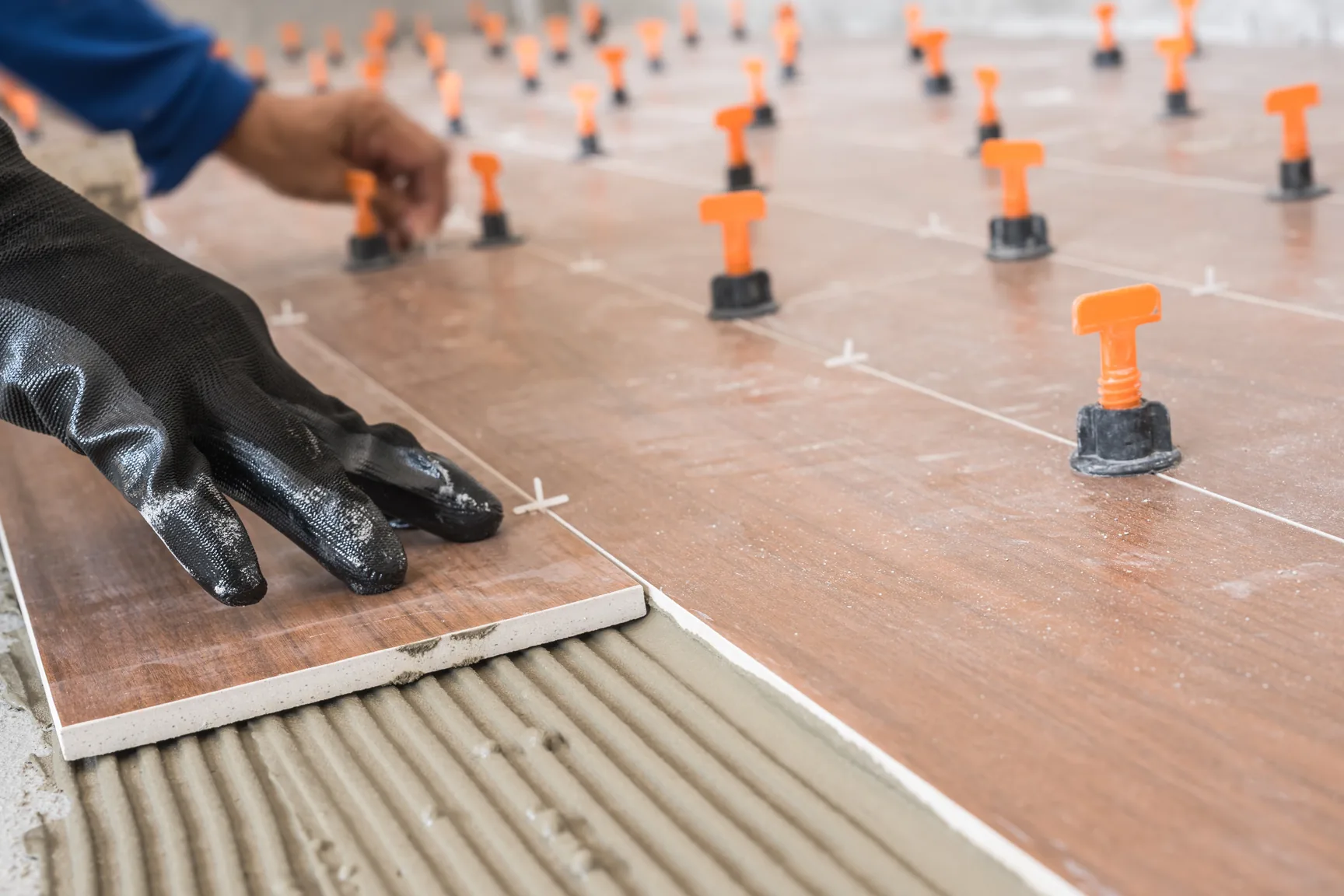
In South Dakota the license a flooring business holds is a tax license, and the floor decides which one: the South Dakota Department of Revenue puts ceramic tile, marble, mosaic and terrazzo installers under its contractor’s excise tax license, while installers of carpet, vinyl, hardwood, laminate and other resilient flooring hold a sales tax license instead. Workers’ compensation is not compelled here, but an employer without it is treated as having elected out of the workers’ compensation title and can be sued at law by an injured worker, or face a claim under the title with added benefits.
Around those two findings sit the rest of the picture. There is no state contractor license of any kind, so contractor licensing is a local matter. Renovators who disturb lead paint answer to EPA. And the South Dakota Department of Agriculture and Natural Resources, Asbestos Section runs a state program whose rules reach flooring removal once old tile, sheet flooring or mastic is friable or made friable. Each of those findings gets its own section further down, printed as verified, set beside the source’s own words, and followed by questions a crew lead can ask before the job is priced.
The policies themselves, and what they do for a flooring business anywhere, are on the flooring contractor insurance page and the pages it links to. Here the subject is South Dakota alone, whether your work is residential flooring in occupied homes, commercial flooring under general contractors, carpet installation, or tile and stone setting.
South Dakota tax licenses for flooring installers, sorted by the floor going down
South Dakota issues no state contractor license for flooring work, and no general or home improvement contractor license. The state’s own list of every occupational licensing agency carries electrical and plumbing commissions but no contractor licensing board. What the state does require of a flooring business is a tax license from the Department of Revenue, and which one depends on the floor being installed.
Authority: SDCL § 10-46A-7; SDCL § 10-46A-12.1
Start with the general rule the South Dakota Department of Revenue sets for anyone who builds or installs on real property:
“Any person entering into a contract for construction services (as defined in Division C of the Standard Industrial Classification Manual of 1987) or engaging in services that include the construction, building, installation, or repair of a fixture to real property must have a South Dakota contractor’s tax license.”
No state contractor license is not the same as nothing being required. The Department of Revenue requires a contractor’s excise tax license of anyone who contracts for construction services or installs fixtures to real property, and its flooring guidance puts ceramic tile, marble, mosaic and terrazzo installers under that license, while installers of carpet, vinyl, hardwood, laminate and other resilient flooring hold a sales tax license instead. The excise tax license number is posted with the building permit where the local government requires one. Contractor licensing itself is local: Sioux Falls, for example, licenses residential building contractors for permitted work and says floor coverings such as tile or carpet do not need that license.
The department’s flooring guidance sets the two kinds of installer side by side, and each column ends in a short instruction. The tile, marble, mosaic and terrazzo column reads:
“Contractors must have a contractor’s excise tax license.”
The carpet, vinyl, hardwood, laminate and resilient column reads:
“The installer must have a sales tax license.”
Plenty of shops set tile in one house and lay carpet in the next, which puts them on both sides of that line. Which license fits a mixed operation, and how a job that combines materials is reported, are tax questions for the department or your accountant; this page does not answer them. What it can do is point out that the distinction tracks the same line the service pages draw between a tile and stone shop and a carpet installation business, so the way you describe your work to an underwriter and the way you describe it to the tax office ought to agree.
The excise license also reaches the job site, through the building permit:
“A contractor shall post his excise tax license number assigned pursuant to this chapter with the building permit for a realty improvement project.”
That ties a tax registration to the paperwork a local building department handles, which is where the licensing question moves next. The City of Sioux Falls, Residential Building Contractor’s License is the record’s example of a local rule. It reaches contractors doing permitted construction work on houses, duplexes and townhomes inside the city limits; the city says floor coverings such as tile or carpet do not require a permit and so do not require the license. The city states the floor-covering point in its own words:
“If you are doing work that would not require a building permit (floor coverings like tile or carpet, or painting, cabinets, etc), you would not be required to obtain this license.”
One city’s answer is not every city’s answer. A few working habits help:
- Bidding in an unfamiliar town? Ask its building office whether the job needs a permit and whether it licenses contractors for that kind of work.
- Keep the tax license that matches each kind of floor you install on file where the office can find it, so a general contractor’s paperwork request does not wait on the owner.
- When a floor job grows into permitted work, such as a wall or a subfloor repair, check the local license question again; the Sioux Falls line above turns on the permit.
Proof of insurance is a separate document from any license; see the commercial flooring contractor insurance page for the certificate a general contractor wants, and the residential page for what a homeowner may ask.
EPA certifies lead-safe renovation for South Dakota flooring firms
South Dakota does not run its own lead renovation program. EPA administers the federal Renovation, Repair and Painting (RRP) Rule in South Dakota directly, so a flooring firm that disturbs paint in older homes or child care facilities is certified by EPA, not by a state agency.
Authority: 40 CFR Part 745, Subpart E
The federal rule reaches anyone paid to disturb paint in housing and child-occupied facilities built before the year in the quote below, including sole proprietors, so pulling painted baseboards, shoe molding, thresholds or door casings can bring a flooring job under it. The firm holds EPA certification and its workers are trained in lead-safe work practices. South Dakota’s Department of Health runs a childhood lead poisoning prevention program, which educates families and tracks blood lead results; it certifies no renovators.
“In general, anyone paid to perform work that disturbs paint in housing and child-occupied facilities built before 1978 must be certified in lead-safe work practices. This includes all firms, even sole proprietorships.”
The federal agency’s reach in South Dakota goes beyond renovation. EPA lists the state among those where it runs the lead-based paint activities program as well:
“EPA administers the Lead-Based Paint Activities Program in Alaska, Arizona, Florida, Idaho, Montana, Nevada, New Mexico, New York, South Carolina, South Dakota and Wyoming, as well as the territories of American Samoa, Guam, the Northern Mariana Islands and the U.S. Virgin Islands, and most Tribal lands.”
The state’s own lead work sits elsewhere, with a different purpose. The state’s health department describes its program this way:
“The Program provides lead exposure prevention education and support to the families of children exposed to lead.”
So the certificate that matters on a flooring job here is a federal one, held by the firm, with trained workers on the crew. Where a floor job meets paint is usually at the edges, which is why the obligation sentence names baseboards, shoe molding, thresholds and door casings. Useful questions at the walkthrough:
- How old is the building? The quote above turns on the year it was built, so record the answer on the estimate.
- Is it a home, or a facility where children spend time? The federal rule names both.
- Painted trim: does your crew pull it, or a carpenter, or the owner? Know whose work disturbs the paint.
- Training: who in your firm holds it, and will that person be on this job?
Older houses raise all of these at once; the residential flooring contractor insurance page spends time on them, and lead claims under a policy belong to the general liability page.
South Dakota asbestos rules and the friable line in old floor tile and mastic
A state asbestos program operates in South Dakota. The Department of Agriculture and Natural Resources certifies asbestos contractors and workers under state law and enforces the federal asbestos emission standard, which it adopts by rule. Its rules reach flooring removal when the tile, sheet flooring or mastic is friable or is made friable; intact resilient flooring removed without crumbling it stays outside the certification requirement.
Authority: SDCL § 34-44-5; SDCL § 34-44-7; ARSD § 74:31:01:01(4), (10); ARSD § 74:31:02:03; ARSD § 74:36:08:02; 40 CFR Part 61, Subpart M
The statute sets the duty in terms of a certificate:
“No asbestos contractor may work on an asbestos project unless the asbestos contractor holds a certificate issued by the department under § 34-44-10 .”
Whether a flooring job is an asbestos project turns on two definitions in the department’s rules. The first defines the project by friable material:
“"Asbestos abatement project," any demolition, renovation, repair, construction, or maintenance activity of any public or private facility that involves the repair, enclosure, encapsulation, removal, salvage, handling, or disposal of friable asbestos-containing material with the potential of releasing asbestos fibers into the air or environment”
The second puts resilient floor covering in the nonfriable first category:
“"Category I nonfriable asbestos-containing material (ACM)," asbestos-containing packings, gaskets, resilient floor covering, and … products containing more than one percent asbestos”
Before any renovation, the department’s guidance has a certified asbestos inspector check the affected area for asbestos. Old resilient floor covering is a nonfriable material under the rules, and it can be removed by trained but uncertified workers so long as it stays nonfriable; the department says power tools such as pneumatic chippers or power saws make it friable, and sanding, cutting, grinding or abrading does the same. Once the flooring is friable or in poor condition, removal is regulated: certified individuals do the work for a certified asbestos contractor, and above the quantities quoted below the job is notified to the department in advance.
“Prior to the commencement of any demolition or renovation, the affected structure or part of the structure where the work is to take place must be thoroughly inspected by a certified asbestos inspector for the presence of asbestos.”
“For renovations, notifications are required when the amount of regulated asbestos material that will be disturbed is at least 260 linear feet or 160 square feet.”
The department’s floor-tile guidance is where the friable line meets the scraper. It first says what intact material may be handled without certified workers, and then what takes that allowance away:
“According to the current regulations, Category I nonfriable materials are not required to be handled or disposed of as regulated asbestos materials as long as they remain nonfriable during removal and handling. Also, nonfriable materials are not required to be handled by certified asbestos workers as long as they remain nonfriable.”
“In order to be considered nonfriable, they must not be in poor condition or made friable by sanding, cutting, grinding or abrading. The EPA has determined that the use of power tools such as pneumatic chippers or power saws will cause these materials to become friable.”
Read together, the removal method is the hinge. The same tile taken up whole and taken up with a power tool land on opposite sides of the certification duty. The rules also carry a narrow exemption from certification and training:
“In addition to persons exempted under SDCL 34-44-33 , persons working on small-scale, short-duration activities are exempt from the certification and training requirements of this article.”
Taken together, those rules suggest a few working habits:
- On a renovation, ask for the certified inspector’s findings before you price the tear-out, and read what they say about the floor you are replacing and anything under it.
- Spell out how the old floor comes up, in the written proposal. If the plan shifts toward chipping, sawing or grinding, stop and settle who does the work before the tools come out.
- Crumbling tile is not intact tile, so tell the crew lead what condition the material was in at the walkthrough.
- File the inspection, the proposal and any change order together, by job.
Policy questions about asbestos claims and finished work belong to the general liability page; contract insurance terms on a commercial tear-out, to the commercial page; tile demolition, to the tile and stone page.
South Dakota workers’ compensation: no mandate, and what an uninsured employer faces
South Dakota does not compel employers to carry workers’ compensation insurance. According to the Department of Labor and Regulation, no law requires any employer to carry it, and the statute treats an employer that does not secure coverage as having elected not to operate under the workers’ compensation title, which leaves it open to a civil suit by an injured worker.
Authority: SDCL § 62-3-3; SDCL § 62-3-5; SDCL § 62-3-11; SDCL § 62-5-1; SDCL § 62-5-2; SDCL § 62-5-5; SDCL § 62-5-7; SDCL § 58-20-15
The South Dakota Department of Labor and Regulation, Division of Labor and Management puts the first half in plain words, and adds the second in the same breath:
“There is no law in South Dakota requiring any employer to carry workers’ compensation insurance. However, it is highly recommended. An uninsured employer may be sued in civil court by an injured worker.”
The statute reaches the same place by a different road. It addresses a covered employer in the language of duty:
“Except as otherwise provided in §§ 62-5-5 and 62-5-6 , any employer, coming within the compensation provisions of this title, shall secure the payment of compensation to the employer's employees in one of the ways provided by § 62-5-2 or 62-5-3 .”
It then says what follows for an employer that does not comply:
“Any employer other than the state, a municipality, or other political subdivision of this state, who has failed to comply with the provisions of §§ 62-5-1 to 62-5-5 , inclusive, shall be deemed to have elected not to operate under the provisions of this title.”
That election is the half a quick reading misses. It is not a quiet exit; it changes the injured worker’s options, and the statute spells them out:
“Any employee, who is employed by an employer who is deemed not to operate under this title in accordance with § 62-5-7 , or the dependents of such deceased employee, may elect to proceed against the employer in any action at law to recover damages for personal injury or death; or may elect to proceed against the employer in circuit court under the provisions of this title, as if the employer had elected to operate thereunder by complying with §§ 62-5-1 to 62-5-5 , inclusive. The measure of benefits shall be that provided by § 62-4-1 plus twice the amount of other compensation allowable under this title.”
The law covers nearly all employers and presumes them to accept it, but only an employer that insures, or is approved by the department to self-insure, is treated as operating under it. A flooring contractor without coverage can be sued at law by an injured employee, or the employee can claim under the workers’ compensation title with the added benefits quoted below, and the department recommends carrying coverage to avoid that suit. Coverage comes from private insurers licensed in the state, bought through an agent; the state does not write it, and an employer the market turns down is placed through a plan the director of insurance approves that every licensed writer must join.
For a business that does secure coverage, the statute names the kinds of insurer that may write it:
“An employer may secure the payment of compensation to any employee by insuring and keeping insured the payment of the compensation with any stock corporation writing workers' compensation insurance or any mutual employer's liability association authorized to transact the business of workers' compensation insurance in this state or in an association authorized to exchange reciprocal or interinsurance contracts by individuals, partnerships, or corporations.”
None of those is a state insurer, and South Dakota has no state fund. The department’s employer page closes the loop with a recommendation:
“To avoid civil lawsuit, it is our recommendation you carry workers' compensation insurance for your employees.”
So the decision a South Dakota flooring owner faces is not whether the law will make you buy a policy. It is whether to meet an injured installer’s claim with insurance behind you or without it, under the terms quoted above. Payroll questions, and the treatment of installers paid as subcontractors, belong to the policy rather than to South Dakota; the workers’ compensation page sets them out.
The South Dakota offices behind each of these findings
The South Dakota Department of Labor and Regulation, Division of Insurance is the insurance regulator. Licenses held by insurance agencies, ours among them, are public on NIPR.com.
Four more offices hold the remaining pieces, linked to their own sites, with roles as the record verified them:
- South Dakota Department of Revenue, whose role is this: issues the contractor’s excise tax license and the sales tax license that a flooring business holds, depending on the floor being installed; there is no state contractor licensing board
- U.S. Environmental Protection Agency, whose role is this: administers the federal Renovation, Repair and Painting Rule in South Dakota and certifies renovation firms there
- South Dakota Department of Agriculture and Natural Resources, Asbestos Section, whose role is this: certifies asbestos contractors and workers, receives renovation and demolition notifications, inspects, and enforces the federal asbestos emission standard adopted by the department’s rule
- South Dakota Department of Labor and Regulation, Division of Labor and Management, whose role is this: administers the workers’ compensation title: self-insurance approval, injury reports, coverage verification and decision of disputed claims
The list has no contractor licensing board, because the state has none, and no state workers’ compensation fund. Week to week, a flooring business mostly hears from the tax office and from the building department of the town where the job sits.
South Dakota metro markets and their counties
The U.S. Census Bureau delineates a short list of metropolitan areas that carry South Dakota in their names, and every one of them appears below. Cards for cross-border metros list only their South Dakota counties, the places where the local licensing question and the state tax license both apply.
Sioux Falls, SD-MN
In South Dakota, this metro takes in: Lincoln County, McCook County, Minnehaha County and Turner County.
The South Dakota Department of Revenue’s excise or sales tax license follows the floor being installed statewide, and any contractor license is set locally rather than by the state.
Rapid City, SD
Counties in this metro: Custer County, Meade County and Pennington County.
The South Dakota Department of Revenue’s excise or sales tax license follows the floor being installed statewide, and any contractor license is set locally rather than by the state.
Sioux City, IA-NE-SD
In South Dakota, this metro takes in: Union County.
The South Dakota Department of Revenue’s excise or sales tax license follows the floor being installed statewide, and any contractor license is set locally rather than by the state.
Building a South Dakota flooring insurance program from these pieces
Rules sit where the findings above put them; the coverage that answers for the work has pages of its own: general liability for injury and damage to others, finished work and tear-out included; workers’ compensation for the crew and subcontracted installers; and inland marine coverage for contractors’ tools and equipment for the saws, trowels and material that travel between jobs.
Tile setters and carpet crews meet different jobs and different tear-outs, so the carpet installation and tile and stone pages take each on its own terms. Pricing South Dakota work begins with a quote request.
Residential Flooring Contractor Insurance
A panel for South Dakota in rows. Contractor license: no statewide license reaches this work. It connects to the General Liability page. Lead-safe renovation: the federal program applies in this state. It connects to the Residential Flooring Contractor Insurance page. Asbestos flooring and mastic: a state program reaches flooring removal. It connects to the General Liability page. Workers’ compensation: not compulsory for every employer. It connects to the Workers Compensation page. Each row pairs a state rule with the page on this site that discusses it. No figures are shown.
Related coverage and services
What we insure
Outside authorities
South Dakota flooring contractor insurance questions
Which South Dakota tax license does a tile setter hold, and which does a carpet installer hold?
The South Dakota Department of Revenue puts ceramic tile, marble, mosaic and terrazzo installers under its contractor’s excise tax license, and installers of carpet, vinyl, hardwood, laminate and other resilient flooring hold a sales tax license instead. The excise tax license number is posted with the building permit where the local government requires one.
Is there a statewide contractor board in South Dakota that licenses flooring work?
No. South Dakota issues no state contractor license for flooring, and no general or home improvement contractor license, and the state’s list of occupational licensing agencies carries no contractor licensing board. Contractor licensing is local. Sioux Falls, for example, licenses residential building contractors for permitted work and says floor coverings such as tile or carpet do not need that license.
Does a state agency or EPA certify South Dakota flooring firms that disturb old paint?
EPA. South Dakota does not run its own lead renovation program, so a flooring firm that disturbs paint in older homes or child care facilities is certified by EPA, not by a state agency. The state’s health department runs a childhood lead poisoning prevention program; it certifies no renovators.
May an uncertified South Dakota crew take up old resilient floor tile?
Trained but uncertified workers may remove it so long as it stays nonfriable. The South Dakota Department of Agriculture and Natural Resources, Asbestos Section says power tools such as pneumatic chippers or power saws make it friable, and sanding, cutting, grinding or abrading does the same. Once the flooring is friable or in poor condition, certified individuals do the work for a certified asbestos contractor, and a certified asbestos inspector checks the affected area before any renovation.
What happens if a South Dakota flooring business does not carry workers’ compensation?
The South Dakota Department of Labor and Regulation, Division of Labor and Management says no law in South Dakota requires an employer to carry it, but the statute tells a covered employer to secure payment of compensation and treats one that does not as having elected not to operate under the workers’ compensation title. An injured employee of that employer may sue at law, or may claim under the title with added benefits, and the department recommends carrying coverage to avoid the civil suit.
Can a South Dakota flooring contractor buy workers’ compensation from the state?
No. Coverage comes from private insurers licensed in the state, bought through an agent, or from self-insurance the department approves; the state does not write it. An employer the market turns down is placed through a plan the director of insurance approves, which every licensed writer must join.
Which South Dakota office oversees the insurers that write flooring policies?
The South Dakota Department of Labor and Regulation, Division of Insurance. It licenses the insurers that write workers’ compensation and general liability in South Dakota and administers the plan that places employers the voluntary market turns down, while the South Dakota Department of Labor and Regulation, Division of Labor and Management administers the workers’ compensation title.
This page describes insurance for flooring contractors and installers operating in this state. It is general information, not legal advice and not a statement of coverage. Licensing, lead-safe and asbestos requirements change; verify current requirements with the agency named before relying on them.
Get a quote for your South Dakota flooring work
Tell us which floors your South Dakota crews put down, what they pull up first and whether you carry comp today, and we will build the program around it.