
Flooring Contractor Insurance by State
Minnesota Flooring Contractor Insurance
Minnesota’s contractor law lists floor covering, wood floors and tile as special skills, and how many skills a flooring business sells a homeowner decides which state credential it needs.
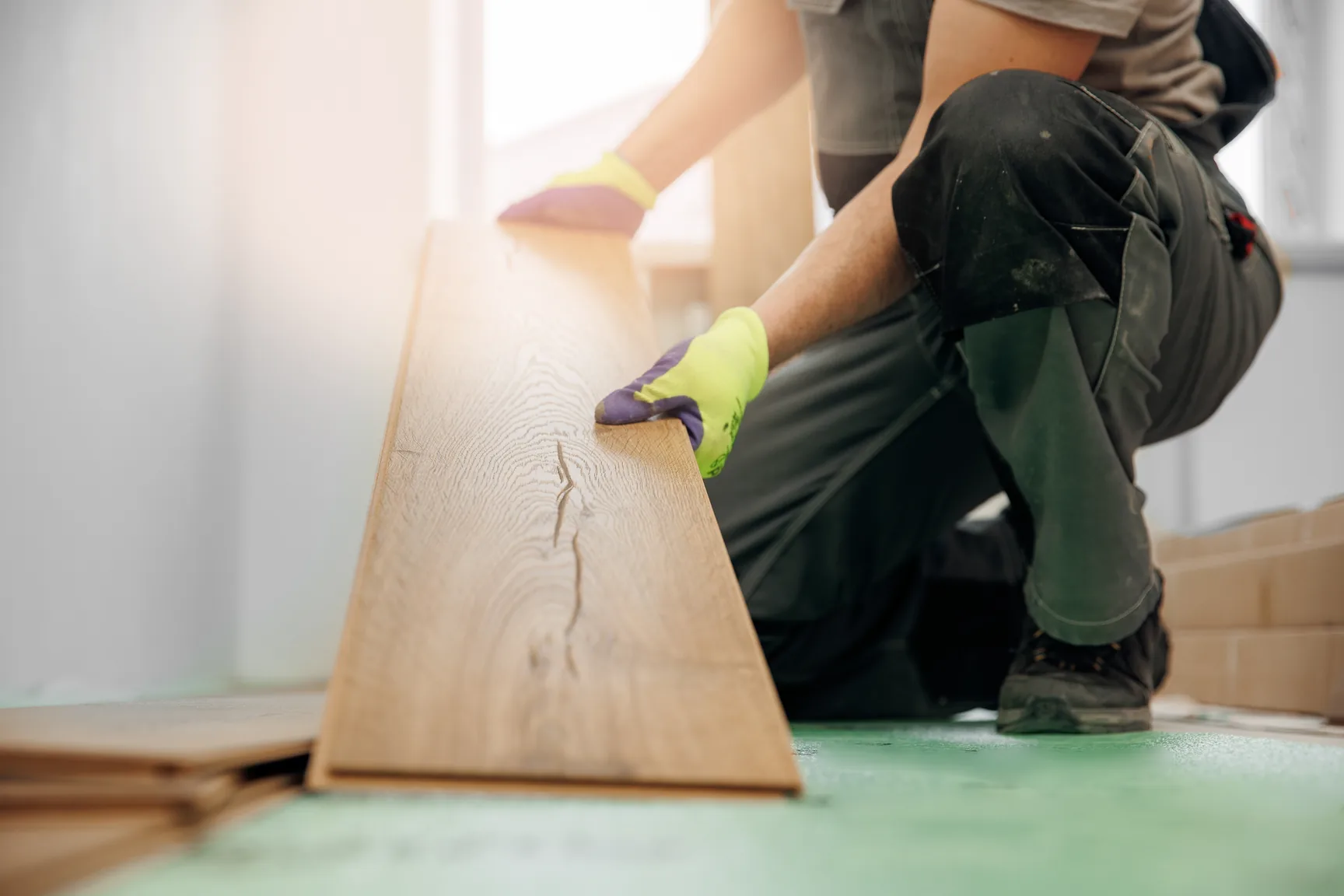
Minnesota sorts flooring businesses by how many special skills they sell: a flooring specialist that stays inside interior finishing registers with the Minnesota Department of Labor and Industry, while a business that offers a homeowner flooring together with another special skill, such as carpentry or drywall, needs the residential remodeler license. Around that split, EPA administers the federal lead renovation rule while two state statutes add certification duties of their own, the state’s asbestos program reaches resilient flooring once it is friable or made friable, and workers’ compensation is compulsory for every employer and is bought in the private market, because Minnesota has no state fund.
That first point is what sets the state apart. Minnesota writes floor covering, wood floors and tile into a statewide list of skills and then lets the shape of what you sell decide which credential applies. A crew that lays tile and nothing else and a crew that lays tile and also frames a new closet wall can stand in the same house under different rules.
Policy mechanics, which do not change at the state line, are explained on the flooring contractor insurance page and the pages it links to. Here the focus is Minnesota alone, whether you run a residential flooring crew in occupied homes, a commercial flooring firm working under general contractors, a carpet installation business or a tile and stone shop.
Minnesota’s special-skill list decides whether a flooring business registers or holds a license
Minnesota’s contractor law names flooring work outright. Its list of special skills puts floor covering, wood floors and ceramic, marble and quarry tile under interior finishing, and the Department of Labor and Industry sorts flooring businesses by that list: a residential license for a contractor who sells a homeowner work across more than a single special-skill category, and a state contractor registration for the flooring specialist who stays inside interior finishing on homes and for commercial work.
Authority: Minn. Stat. §326B.802, subds. 12, 15 and 16; Minn. Stat. §326B.805, subds. 1 and 6; Minn. Stat. §326B.701, subds. 1–3
Start with the list, since everything else in this section hangs from it. The statute groups building trades into categories it calls special skills, and flooring sits in the one headed interior finishing:
“(d) Interior finishing. Interior finishing includes work in any of the following areas: (1) floor covering; (2) wood floors; … (6) ceramic, marble, and quarry tile;”
All three flooring items sit in that one category, so a flooring business that moves among them is still working inside interior finishing.
“"Residential remodeler" means a person in the business of contracting or offering to contract with an owner to improve existing residential real estate by providing two or more special skills as defined in this section.”
That definition is where the count matters, and the Minnesota Department of Labor and Industry states the consequence in plain words on its own skill sheet:
“A contractor who provides services in more than one special skill area must be licensed. Specialty contractors who provide only one special skill are not required to have a state license (except residential roofers).”
Offering more than the interior finishing category to a homeowner improving an existing home, for example flooring together with carpentry or drywall, puts a flooring business under the residential remodeler or residential building contractor license. A flooring specialist that stays inside interior finishing is exempt from that license and instead registers with the department before providing building construction or improvement services, as does any contractor doing commercial work without a residential license; the registration asks for workers’ compensation and unemployment insurance compliance where the business has employees. Cities and counties may add their own license for specialty contractors and for commercial work.
The registration is not a lighter version of the license so much as a different gate, and the department describes who passes through it:
“The Contractor Registration Program is for those who provide one specialty skill for residential projects and for all commercial projects, if they do not hold a residential contractor’s license.”
Read with the obligation sentence, that gives a flooring owner three rough lanes. A specialist laying floors in homes registers. A firm doing commercial installs registers unless it already holds the residential license. A firm that sells a homeowner a remodel reaching past interior finishing holds the residential license.
Cities and counties are the last layer. The department’s answer on local licensing draws the line this way:
“Cities and counties cannot require a contractor who has a state license to obtain a local license for work that is covered under the state licensing requirements. However, they can require a local license for Certificate of Exemption holders and specialty contractors, and state licensed contractors performing work outside the scope of the state license …”
A specialty contractor and a commercial firm are both named there, so the local question is live for most flooring businesses in Minnesota, even with the state credential in hand.
Habits that keep the lanes straight:
- Sort each residential estimate by scope before it goes out. If a bathroom job has grown from tile into new drywall or a rebuilt vanity wall, ask whether your firm is selling that work or a separate trade is contracting for it with the owner.
- Keep the registration or license current before the first job of the season, since the statute places the registration ahead of any work.
- Ask the building department of each city or county where you have not worked before whether it licenses specialty contractors, and ask separately about commercial work.
- Remember that the registration asks about workers’ compensation and unemployment insurance where you have employees; the workers’ compensation page covers how that policy is built.
Lead renovation work in Minnesota: EPA’s program, with two state statutes alongside it
Minnesota is not on EPA’s list of states authorized to run their own lead renovation, repair and painting (RRP) program, so EPA administers the federal renovation rule in Minnesota. State law adds its own layer: a licensed residential contractor or remodeler doing covered renovation on an older home must hold the federal certification, and Minnesota’s lead statute requires a business that performs renovation for compensation to be certified as a renovation firm by the commissioner of health.
Authority: Minn. Stat. §326B.106, subd. 14; Minn. Stat. §326B.805, subd. 1a; Minn. Stat. §144.9505, subd. 1h; Minn. Stat. §144.9501, subd. 26b; 40 CFR Part 745
The federal half comes from EPA’s own list of the states it has handed the program to. Minnesota appears on it only through a tribal program, not as the state:
“EPA administers the RRP Program in most Tribes, states and territories, but has authorized the following to operate their own programs: Alabama, Delaware, Georgia, Iowa, Kansas, Massachusetts, Mississippi, North Carolina, Oklahoma, Oregon, Rhode Island, Utah, Vermont, Wisconsin and the Minnesota Chippewa Tribe-Boise Forte (Nette Lake).”
Disturbing painted baseboards, trim or doors in an older Minnesota home brings the federal renovation rule and EPA certification into the job. If it holds a Minnesota residential contractor or remodeler license, the licensing statute makes that federal certification a condition of the work and lets the Department of Labor and Industry ask for proof of it. The state lead statute also requires renovation firm certification from the commissioner of health for renovation performed for compensation, and it licenses lead abatement workers, supervisors and firms separately.
The first state layer is written into the contractor licensing law, so it follows the residential license from the section above. A flooring firm that holds that license and takes on covered renovation carries the federal certification as a condition of its license:
“A residential building contractor, residential remodeler, manufactured home installer, or residential roofer licensed under section 326B.805 performing renovation as defined by Code of Federal Regulations, title 40, section 745.83, on a residential structure constructed prior to 1978 must be certified in accordance with Code of Federal Regulations, title 40, section 745.89, unless the property has been determined to meet an exemption under Code of Federal Regulations, title 40, section 745.82.”
The second state layer sits in the lead statute and is not tied to either credential. It is stated as a duty on the business:
“A person who performs or employs individuals to perform renovation for compensation must obtain certification as a renovation firm.”
The sources behind this page show that duty and that the certificate comes from the commissioner of health, but not how the Minnesota Department of Health, lead program issues it next to a federal certificate. Ask the department which certificate it expects a flooring firm doing renovation for pay to hold, and keep the answer with your license papers.
On a floor job, paint shows up at the edges: baseboards pulled so the new floor can run under them, trim, doors. At an older home, three walkthrough questions help:
- When was the house built? The state license condition quoted above turns on the building’s age, so write the answer on the estimate.
- Is your crew removing or cutting painted trim, or is a carpenter or painter doing it? Know which firm disturbs the paint before the start date.
- Who in your firm holds the federal certification, and does your firm hold the state’s renovation firm certificate the lead statute describes?
Older homes get room of their own on the residential flooring contractor insurance page, and the general liability page covers how a claim involving lead or other contaminants is treated.
Old resilient flooring under Minnesota’s asbestos program, where friability is the dividing line
Minnesota runs its own asbestos program, and it reaches flooring removal when the material is friable or will be made friable. The Department of Health licenses the contractors who do asbestos-related work, and the Pollution Control Agency classes resilient floor coverings as Category I asbestos-containing material that must go to a licensed abatement contractor once it is friable or rendered regulated. Nonfriable floor tile taken up intact with hand tools may be removed without a license, and in houses and small residential buildings the Department of Health’s project rules leave floor tiles and sheeting out of their definitions.
Authority: Minn. Stat. §326.71, subd. 4; Minn. Stat. §326.72, subd. 1; Minn. R. 4620.3100, subps. 21, 27b and 31; Minn. R. 7011.9920 (40 CFR Part 61, subpart M)
Two agencies share this ground. The Minnesota Department of Health, asbestos program licenses the contractors, and the Minnesota Pollution Control Agency applies the federal emission standard and publishes the guidance that speaks most directly to floors. That guidance starts by putting resilient flooring in a named category:
“Category I ACM consists of asbestos-containing gaskets, resilient floor coverings, and …”
Before anything is pulled, somebody has to know what the floor is made of, and the guidance is specific about who that can be:
“In Minnesota, only a MDH licensed asbestos inspector can perform an asbestos inspection. You do have an option to assume materials contain asbestos and handle the materials as such.”
From there the method decides the route. Intact tile that comes up by hand stays on one side of the line:
“Nonfriable Category I ACM that is removed by hand tools and not subject to more then de minimis breakage may be removed by unlicensed contractors.”
Aggressive methods move it to the other side, and the guidance lists them:
“Examples of removal methods that would render the Category I ACM to RACM are shot blasting, mechanical chipping, intentional burning, or specific grinding, sanding, cutting, or abrading.”
“Category I ACM that has or will become friable or rendered into RACM must be abated by a Minnesota Department of Health (MDH) licensed asbestos abatement contractors.”
Old resilient flooring is inspected by a licensed asbestos inspector before tear-out, or treated as asbestos-containing. Tile that is removed intact by hand tools, with no more than slight breakage, may be taken up by an unlicensed contractor; sanding, grinding, mechanical chipping or shot blasting renders it regulated, and linoleum with an asbestos paper backing is generally treated as friable, so that work goes to a Department of Health licensed abatement contractor. The source documents do not address mastic separately. Commercial and other regulated buildings also carry Pollution Control Agency notification before renovation or demolition.
Houses get separate treatment in the asbestos rules, which leave floor tiles and sheeting out of the definition of a project in small residential buildings:
“In single-family residences and residential buildings with no more than four dwelling units, asbestos-containing materials excluded from this definition are floor tiles and sheeting, roofing materials, siding, and all ceilings with asbestos-containing material;”
That exclusion is one rule among several. The Minnesota Pollution Control Agency reminds readers that its federal standard and the Department of Health’s requirements are separate questions:
“Remember that whether subject to the NESHAP or not, asbestos work in structures may still be regulated under Minnesota Department of Health (MDH) requirements.”
So the removal method belongs in the bid, not in a decision the crew makes with a scraper in hand. Practices worth adopting:
- On any tear-out of old resilient flooring, ask for the inspection or decide at the bid to treat the material as asbestos-containing, and price the job on that basis.
- Write down, in the proposal, how the floor will come up. If the plan was hand tools and the tile starts breaking up, stop and talk to the owner before anyone reaches for a grinder.
- Treat old linoleum as its own question rather than lumping it in with tile.
Tear-out claims and finished work are taken up on the general liability page, contract terms on a commercial tear-out on the commercial page, and tile demolition on the tile and stone page.
Minnesota workers’ compensation for a flooring payroll: every employer, bought privately
Every Minnesota employer must carry workers’ compensation; there is no minimum number of employees. An employer insures with an insurance carrier authorized to write the coverage in Minnesota or holds a written self-insurance order from the commissioner of commerce, and a willful failure to comply is a gross misdemeanor. The private market writes the coverage, with no state fund, and an employer turned down by a licensed insurer can get coverage through the state’s assigned risk plan, which the statute says is not a state agency.
Authority: Minn. Stat. §176.181, subds. 2 and 4; Minn. Stat. §79.252, subd. 1; Minn. Stat. §79.251, subd. 1(a)(4); Minn. Stat. §79.34, subd. 1; Minn. Stat. §79.35
The duty itself is one sentence of the statute, and it leaves an employer two ways to meet it:
“Every employer, except the state and its municipal subdivisions, liable under this chapter to pay compensation shall insure payment of compensation with some insurance carrier authorized to insure workers' compensation liability in this state, or obtain a written order from the commissioner of commerce exempting the employer from insuring liability for compensation and permitting self-insurance of the liability.”
The Workers’ Compensation Division, Minnesota Department of Labor and Industry closes off the idea that a small crew sits outside it:
“There is no minimum number of employees an employer must have before insurance is required; therefore, an employer with only one part-time employee generally must provide coverage.”
For a flooring business shopping for a policy from an authorized insurer, the department is plain about where to buy one:
“Workers' compensation insurance in Minnesota may be purchased through an insurance agent or directly from an insurance company.”
A business that an insurer will not take still has a door, and the statute is careful about what that door is:
“The purpose of the assigned risk plan is to provide workers' compensation coverage to employers rejected by a licensed insurance company pursuant to subdivision 2.”
“The assigned risk plan shall not be deemed a state agency.”
This ties back to the licensing section. The registration a flooring specialist files asks about workers’ compensation where the business has employees, so the policy is part of getting onto the state’s list as well as part of running crews.
How an underwriter reads a flooring payroll, and how installers you pay as subcontractors are treated, is a question about the policy rather than about Minnesota, and the workers’ compensation page takes it up. Across the border, a neighboring state’s rules apply instead; the findings here stop at the Minnesota line.
Minnesota’s regulators, office by office, for a flooring contractor
The Minnesota Department of Commerce regulates insurance in Minnesota. Its role, as the record verified it: insurance regulator; the commissioner of commerce grants self-insurance orders and administers the assigned risk plan. To check the license of an insurance agency, ours included, use NIPR.com.
Beyond the insurance regulator, each office below holds one piece of the picture. Some links lead to an agency site and some to the statute that gives the office its job; each role is the one the record verified:
- Contractor licensing and registration — Minnesota Department of Labor and Industry: residential building contractor and remodeler licensing and the construction contractor registration, both of which reach flooring work
- Workers’ compensation administration — Workers’ Compensation Division, Minnesota Department of Labor and Industry: oversees and administers the workers’ compensation system and investigates employers that may not carry coverage
- Asbestos emissions, notices and waste — Minnesota Pollution Control Agency: state environmental agency; applies the federal asbestos emission standard, takes renovation and demolition notifications and regulates asbestos waste
- Asbestos contractor licensing — Minnesota Department of Health, asbestos program: licenses asbestos contractors, certifies asbestos workers, supervisors and inspectors, and permits asbestos-related work projects
- Lead credentials — Minnesota Department of Health, lead program: licenses lead abatement workers, supervisors, inspectors and risk assessors, certifies lead firms and, by statute, renovation firms; EPA administers the federal renovation rule in Minnesota
Minnesota has no state workers’ compensation fund to list here. For a local license, the office to call is the city or county where the job sits.
Minnesota metro areas where flooring crews work, with their counties
The cards that follow show the largest metropolitan areas with a principal city in Minnesota, followed by the largest metro across the border that takes in a Minnesota county, as the U.S. Census Bureau delineates them. Each card lists only the Minnesota counties in the metro, since the state credential and any local license follow the job to where it sits.
Minneapolis-St. Paul-Bloomington, MN-WI
Its Minnesota side covers Anoka County, Carver County, Chisago County, Dakota County, Hennepin County, Isanti County, Le Sueur County, Mille Lacs County, Ramsey County, Scott County, Sherburne County, Washington County and Wright County.
The state registration or residential license applies here as it does statewide, and a city or county in the metro may add its own license for a specialty contractor or for commercial work.
Duluth, MN-WI
Its Minnesota side covers Carlton County and St. Louis County.
The state registration or residential license applies here as it does statewide, and a city or county in the metro may add its own license for a specialty contractor or for commercial work.
Rochester, MN
It is made up of Dodge County, Fillmore County, Olmsted County and Wabasha County.
The state registration or residential license applies here as it does statewide, and a city or county in the metro may add its own license for a specialty contractor or for commercial work.
St. Cloud, MN
It is made up of Benton County and Stearns County.
The state registration or residential license applies here as it does statewide, and a city or county in the metro may add its own license for a specialty contractor or for commercial work.
Mankato, MN
It is made up of Blue Earth County and Nicollet County.
The state registration or residential license applies here as it does statewide, and a city or county in the metro may add its own license for a specialty contractor or for commercial work.
Sioux Falls, SD-MN
Its Minnesota side covers Rock County.
The state registration or residential license applies here as it does statewide, and a city or county in the metro may add its own license for a specialty contractor or for commercial work.
Matching coverage to Minnesota flooring work
Whatever the Minnesota rules ask of the business, the policies that answer for the work each have a page:
- Injury or damage claims brought by others, including completed work and tear-out: general liability.
- Your own payroll, including installers paid as subcontractors: workers’ compensation.
- Saws, sanders, stretchers and the material moving between jobs: inland marine coverage for contractors’ tools and equipment.
Which weighs most depends on the work you do; the carpet installation and tile and stone pages treat those trades separately. When the Minnesota picture is clear for your firm, a quote request is the next step.
Residential Flooring Contractor Insurance
A panel for Minnesota in rows. Contractor license: a state license or registration can reach this work. It connects to the General Liability page. Lead-safe renovation: the federal program applies in this state. It connects to the Residential Flooring Contractor Insurance page. Asbestos flooring and mastic: a state program reaches flooring removal. It connects to the General Liability page. Workers’ compensation: bought in the open market. It connects to the Workers Compensation page. Each row pairs a state rule with the page on this site that discusses it. No figures are shown.
Nearby states we also write
Related coverage and services
What we insure
Minnesota flooring contractor insurance questions
Does a flooring-only business in Minnesota need the residential remodeler license?
No. Minnesota’s contractor law lists floor covering, wood floors and ceramic, marble and quarry tile as interior finishing work, and a specialty contractor that stays inside that one category is exempt from the residential license. It registers with the Minnesota Department of Labor and Industry instead before it provides building construction or improvement services.
Our Minnesota crew sometimes hangs drywall or builds trim carpentry on a remodel. Does that change our state credential?
It can. Offering a homeowner more than the interior finishing category on an existing home, for example flooring together with carpentry or drywall, puts a flooring business under the residential remodeler or residential building contractor license issued by the Minnesota Department of Labor and Industry.
What does a Minnesota flooring company that works only on commercial jobs have to do with the state?
Register. The Minnesota Department of Labor and Industry says its contractor registration program covers all commercial projects for contractors that do not hold a residential license, and the registration asks for workers’ compensation and unemployment insurance compliance where the business has employees. A city or county may add a local license for commercial work.
Which lead certifications apply when a Minnesota flooring job disturbs painted trim in an older house?
EPA administers the federal renovation rule in Minnesota, and a licensed residential contractor or remodeler doing covered renovation must hold that federal certification. Minnesota’s lead statute separately requires a business that performs renovation for compensation to be certified as a renovation firm by the commissioner of health.
When does old resilient floor tile in Minnesota have to go to a licensed asbestos abatement contractor?
When it is friable or will be made friable. The Minnesota Pollution Control Agency says nonfriable tile taken up intact with hand tools may be removed by unlicensed contractors, but sanding, grinding, mechanical chipping or shot blasting renders it regulated, and asbestos paper-backed linoleum is generally treated as friable. That work goes to a licensed asbestos abatement contractor.
Does a small Minnesota flooring business need workers’ compensation?
Yes. Every Minnesota employer must carry it, and there is no minimum number of employees. The coverage comes from an insurance carrier authorized to write it in Minnesota, bought through an agent or directly from the company, or from self-insurance approved by the commissioner of commerce.
What can a Minnesota flooring employer do if insurers turn down its workers’ compensation application?
Minnesota has no state fund, but its assigned risk plan exists to provide coverage to employers rejected by a licensed insurer. The statute says the plan is not a state agency.
Which Minnesota department is the insurance regulator?
The Minnesota Department of Commerce. Its commissioner also grants self-insurance orders for workers’ compensation and administers the assigned risk plan, while the Workers’ Compensation Division, Minnesota Department of Labor and Industry oversees the workers’ compensation system.
This page describes insurance for flooring contractors and installers operating in this state. It is general information, not legal advice and not a statement of coverage. Licensing, lead-safe and asbestos requirements change; verify current requirements with the agency named before relying on them.
Get a quote for your Minnesota flooring work
Tell us whether your Minnesota work stays with floors or takes in other trades, what comes up before the new floor goes down and who is on the payroll, and we will build the program around it.