
Flooring Contractor Insurance by State
Maryland Flooring Contractor Insurance
Maryland’s home improvement license reaches tile, wood and other hard flooring in homes but stops short of carpet, commercial jobs need a separate construction license, and workers’ compensation is compulsory.
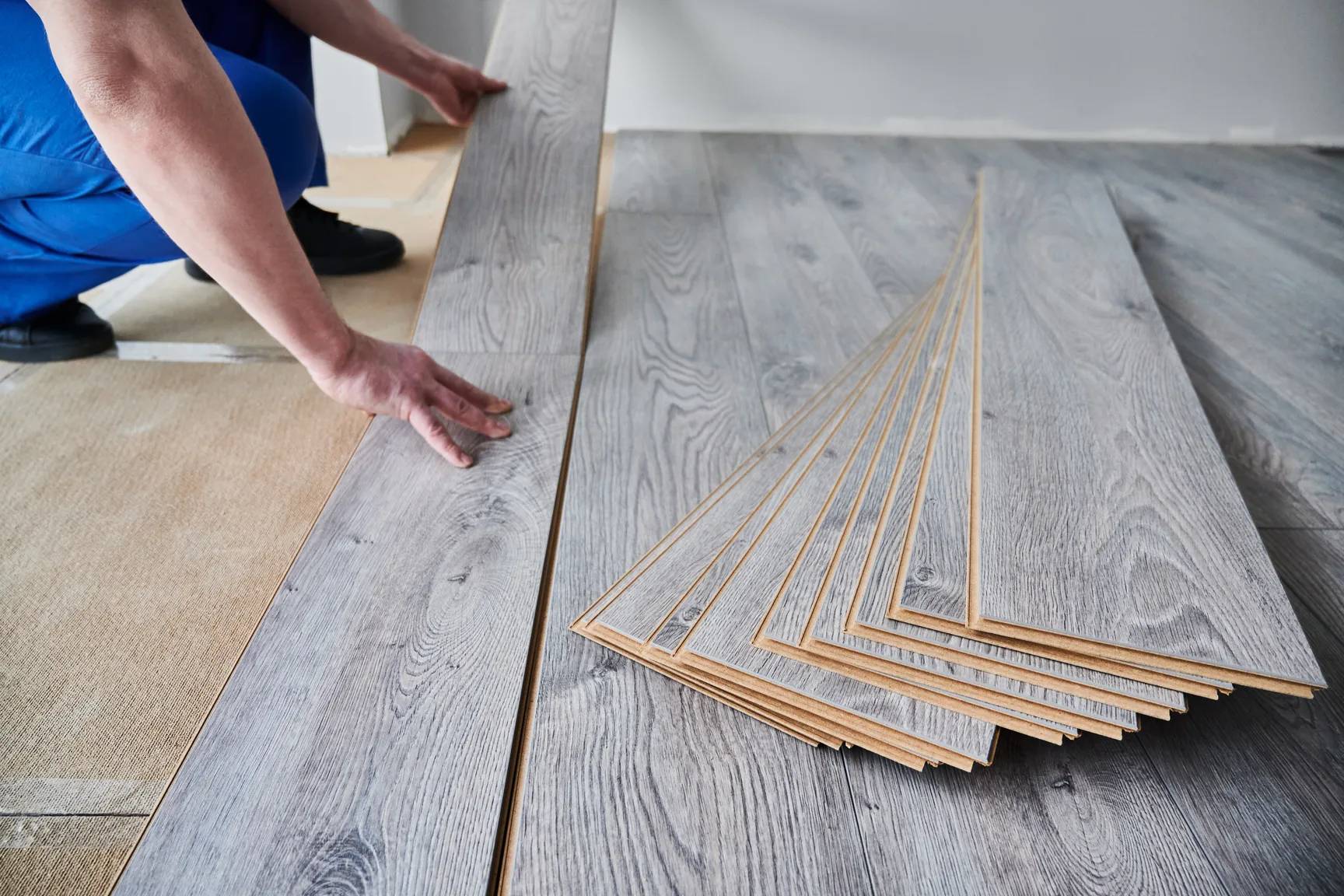
Maryland splits the flooring trade by material: the Maryland Home Improvement Commission says installing tile, wood or other flooring in a home takes a home improvement contractor license, while installing carpet does not. Commercial jobs answer to a different state license, the construction license a county’s circuit court clerk issues, which a Commission licensee does not need for its home improvement contracts; on top of both, EPA certifies lead-safe renovation firms while Maryland layers its own lead rules on older buildings, the state’s asbestos rules turn on whether old flooring stays intact, and workers’ compensation is compulsory.
So one company can sit on both sides of the line. Picture a crew laying carpet in one house on Monday and luxury vinyl in another on Tuesday: for licensing purposes, those are two different kinds of work. The sections below print what the record verified for each rule, quote the source and say what it changes on a job. Policy questions are answered on the flooring contractor insurance page and the pages for residential flooring, commercial flooring, carpet installation and tile and stone businesses.
Maryland’s carpet-versus-hard-flooring line and the two state licenses behind it
Maryland licenses residential flooring work statewide through the Maryland Home Improvement Commission, and the Commission says in its own words that installing tile, wood or other flooring in a home takes a home improvement contractor license, while installing carpet does not. Commercial work falls under a separate state construction license that the Clerk of the Circuit Court issues on application, with no trade examination.
Authority: Md. Code, Bus. Reg. § 8-101(c), (g); § 8-301(a); § 8-302.1; § 8-317; § 8-601(a); § 17-601(c); § 17-602(a)
The Commission put the answer in its licensing questions, and it is unusually direct about the trade:
“Installing carpet and carpet cleaning are not within the definition of "home improvement" so an MHIC license is not required. However, in order to install tile, wood, or other flooring, a home improvement contractor license is required.”
That reading rests on the statute’s definition, which is about residences. Here is how the definition opens, and one of the things it leaves out:
““Home improvement” means: (i) the addition to or alteration, conversion, improvement, modernization, remodeling, repair, or replacement of a building or part of a building that is used or designed to be used as a residence or dwelling place or a structure adjacent to that building; or”
“(v) work done on apartment buildings that contain four or more single–family units; or”
Inside that definition the license rule is short:
“Except as otherwise provided in this title, a person may not act or offer to act as a contractor in the State unless the person has a contractor license.”
A flooring company that contracts directly with a homeowner, tenant or condominium unit owner to install or replace tile, wood, resilient or other hard flooring holds a Commission contractor license, and the statute also requires every licensed contractor to keep general liability insurance at the amount quoted below. A subcontractor working for a Commission-licensed contractor may do the work without its own license, but only a licensed contractor may contract with the homeowner. Carpet-only installation sits outside the home improvement definition. For commercial work, and for residential buildings the home improvement law leaves out, the firm takes out a construction license from the Clerk of the Circuit Court in its home county; a Commission licensee needs no construction license for its home improvement contracts, and local permits still apply.
“A licensed contractor shall maintain general liability insurance in the amount of at least $500,000.”
A crew that works under another firm’s contract has a narrower path. The Commission states both halves of it:
“Home improvement subcontractors may work without a license when performing home improvements for an MHIC licensed contractor in the state of Maryland.”
“The law continues to provide that only MHIC licensed contractors may enter into contracts with homeowners to perform home improvement work.”
Commercial work moves to a separate title of the same article. The construction license rule, the line that keeps home improvement out of it, and the exemption for Commission licensees read this way:
“Except as provided in § 8–317 of this article, a person must have a construction license whenever the person does construction business in the State.”
““Do construction business” does not include home improvement as defined in § 8–101 of this article.”
“A contractor who holds a license under this title is not required to hold a construction license under Title 17 of this article.”
Ways to keep the two licenses straight:
- If you sell any hard-surface installation to homeowners, hold the Commission license, even when most of your volume is carpet.
- If you lay only carpet and work in commercial buildings, put the question to the clerk’s office in your home county before you assume either answer.
- When you sub for a licensed contractor, keep its license number with the job file, because that relationship is what lets your crew work without one.
The liability limit in that statute is a licensing condition; how a policy responds to a claim is set out on the general liability page, and the certificates general contractors request on commercial jobs are covered on the commercial flooring contractor insurance page.
Lead paint and Maryland floor jobs: EPA certification plus the state’s own abatement rules
Because Maryland holds no EPA authorization for the federal lead renovation, repair and painting (RRP) program, EPA certifies renovation firms and renovators in Maryland. Maryland adds its own layer: the Department of the Environment accredits lead paint abatement contractors, and the state’s definition of abatement reaches renovation, repair and painting of lead-containing paint in older residential, public and commercial buildings.
Authority: 40 CFR Part 745; Md. Code, Envir. § 6-1001(b); § 6-1002(a); COMAR 26.16.01.01; COMAR 26.16.01.03; COMAR 26.16.01.04
EPA lists the states it has handed the renovation program to. Maryland is not among them:
“EPA administers the RRP Program in most Tribes, states and territories, but has authorized the following to operate their own programs: Alabama, Delaware, Georgia, Iowa, Kansas, Massachusetts, Mississippi, North Carolina, Oklahoma, Oregon, Rhode Island, Utah, Vermont, Wisconsin and the Minnesota Chippewa Tribe-Boise Forte (Nette Lake).”
A flooring crew that disturbs painted baseboards, shoe molding, thresholds or door casings in housing or child-occupied facilities covered by the federal rule needs EPA firm certification and an EPA-certified renovator, with the building-age threshold in the EPA quote below. Maryland’s rule separately applies its job performance standards to maintenance, repair and renovation that disturbs lead-containing paint in older residential buildings, outside the small-area and owner-occupied exclusions quoted below, and a contractor or supervisor providing lead paint abatement services must be accredited by the Department of the Environment.
“In general, anyone who is paid to perform work that disturbs paint in housing and child-occupied facilities built before 1978 must be certified. This includes all firms, even sole proprietorships.”
The state layer starts with how Maryland’s statute defines abatement. The definition is broad, and one of its items reaches ordinary renovation:
““Abatement” means a set of measures that eliminate or reduce lead–based paint hazards in residential, public, or commercial buildings, bridges, or other structures or superstructures in accordance with standards established by the Department which may include:”
“The renovation, repair, and painting of a lead–containing substance in a residential, public, or commercial building built before 1978.”
The accreditation rule then attaches to whoever provides those services as a contractor or supervisor:
“Except as provided in subsection (c) of this section, unless the person is accredited by the Department under this subtitle, a person may not: (1) Act as a contractor or supervisor for the purpose of providing lead paint abatement services;”
The state rule sets work standards for older residential buildings and lists what falls outside them. These are the lines the obligation sentence points to:
“Except as provided in §§E and F of this regulation, performance of maintenance, repair, or renovation work involving the disturbance of a lead-containing substance in a residential building constructed before 1950 is subject to Regulation .11C(2) and (3), and (5)—(8) of this chapter.”
“Other disturbances of a lead-containing substance involving 3 square feet or less of surface area in a room, except for window removal or replacement.”
“A person performing maintenance, repair, or renovation work in an owner-occupied dwelling unit.”
Painted trim is where a flooring crew usually meets lead: baseboards, shoe molding, thresholds and door casings. Before you price the removal, settle three things:
- When the building went up, measured against each of the dates in the quotes above.
- Whether the owner lives in the unit or rents it out.
- Who on your crew holds the federal renovator certificate, and whether the trim work is yours or another trade’s.
Rental and older housing questions get more room on the residential flooring contractor insurance page.
Intact or crumbling: how Maryland’s asbestos rules sort an old resilient floor
The Department of the Environment holds Maryland’s asbestos program, which licenses asbestos abatement companies, accredits individual workers and supervisors for jobs in public and commercial buildings, and takes project notifications. The state contractor license attaches to work on friable asbestos, and the Department tells contractors plainly that intact, non-friable asbestos flooring in a single-family house may be removed by an unlicensed contractor, while material that is or will be made friable needs a licensed asbestos contractor.
Authority: Md. Code, Envir. § 6-401; COMAR 26.11.21.01; COMAR 26.11.21.02; COMAR 26.11.21.03; COMAR 26.11.21.04; COMAR 26.11.23.01; COMAR 26.11.23.02; COMAR 26.11.23.03
The license rule depends on two definitions. The first sets what a project is, the second what friable means:
““Asbestos project” means any activity involving the demolition, renovation, or encapsulation of friable asbestos materials.”
““Friable asbestos material” means any material that contains more than 1 percent asbestos by weight and that can be crumbled, pulverized, or reduced to powder, when dry, by hand pressure.”
“A business entity or public unit may not engage in any asbestos project unless it is licensed by the Department under this chapter.”
The Maryland Department of the Environment, Asbestos Program applies those lines to a house in its guidance for general contractors, in two sentences a flooring estimator can use:
“Non-friable ACM can be removed by a licensed asbestos contractor, a non-licensed contractor, or the homeowner.”
“If the ACM will be made friable or is already friable (materials that can be crumbled, pulverized, or reduced to powder by hand pressure), it must be removed by a licensed asbestos contractor.”
Before pulling old resilient tile, sheet flooring or black mastic, a flooring contractor has the material identified. In a single-family house, intact non-friable flooring may come up without an asbestos license, but grinding, sanding or other methods that make it crumble turn the job into one for a Department-licensed asbestos contractor. In public and commercial buildings, which under the state rule include offices, stores, warehouses and larger apartment and condominium buildings, removing asbestos-containing material is asbestos abatement, and each individual doing it needs Department accreditation unless the job is a small-scale, short-duration repair; the federal asbestos air rules for renovation also apply.
The accreditation chapter is what carries the rule into offices, stores and larger multi-unit buildings, and it defines those buildings by what they are not:
“An individual may not engage in an asbestos occupation involving any school project or public and commercial building asbestos project without accreditation from the Department.”
““Public and commercial building” does not include a residential apartment building of fewer than 10 dwelling units, a condominium of fewer than 10 dwelling units, or a detached single-family home.”
Working habits that follow from this:
- Spell out, job by job, how the old floor will come up. Lifting tiles whole and grinding mastic off a slab land on opposite sides of the friable line.
- Settle, before the crew arrives, who identifies the old flooring and who stops the job if it starts breaking up.
- On a commercial floor, ask the building owner what it already knows about the material under the carpet or tile you are replacing.
How liability coverage treats asbestos and finished work is a general liability question; tile tear-outs get their own treatment on the tile and stone page.
Maryland workers’ compensation and the installers the Act presumes are employees
Securing workers’ compensation for covered employees is mandatory for each Maryland employer, most often by insuring with an authorized insurer, and the Act presumes anyone working for hire is a covered employee unless the employer shows otherwise. A state-created insurer, organized by its own statute as a private, nonprofit, nonstock corporation, writes the coverage alongside private insurers and is the insurer of last resort, so it is described here by what it does rather than by name.
Authority: Md. Code, Lab. & Empl. § 9-202; § 9-227(a); § 9-401(b); § 9-402(a); § 9-508(a); § 9-1107(b)
“Subject to subsections (b) through (f) of this section, each employer shall secure compensation for all covered employees of the employer by: (1) maintaining insurance with an authorized insurer;”
The statute defines the insurers that satisfy that first method by legal form, not by name:
““Authorized insurer” means a stock corporation or mutual association that is authorized under the Insurance Article to provide workers’ compensation insurance in the State.”
Owners who rely on outside installers should read the presumption twice:
“An individual, including a minor, is presumed to be a covered employee while in the service of an employer under an express or implied contract of apprenticeship or hire.”
“To overcome the presumption of covered employment, an employer shall establish that the individual performing services is an independent contractor in accordance with the common law or is specifically exempted from covered employment under this subtitle.”
With even one installer on payroll, a Maryland flooring contractor secures coverage before the work starts; an installer paid as an independent contractor counts as a covered employee unless the employer can show independence under the common law. A principal contractor is liable for compensation to a subcontractor’s workers on its jobs, which is why general contractors ask flooring subcontractors for proof of coverage. Sole proprietors fall outside the Act unless they elect coverage, and certain corporate officers and limited liability company members may elect out. Failing to secure compensation is a misdemeanor carrying the fine and jail term quoted below.
“A principal contractor is liable to pay to a covered employee or the dependents of the covered employee any compensation that the principal contractor would have been liable to pay had the covered employee been employed directly by the principal contractor if:”
“Unless an election is made in accordance with this section, a sole proprietor is not a covered employee.”
“An employer who is subject to this title and fails to secure payment of compensation in accordance with § 9–402 of this title or fails to pay an award of compensation is guilty of a misdemeanor and on conviction is subject to a fine not exceeding $5,000 or imprisonment not exceeding 1 year or both.”
A one-person shop that adds a helper has left the sole proprietor line behind. How payroll, subcontracted installers and their certificates affect a policy is explained on the workers’ compensation page.
Maryland offices that license, inspect and insure flooring work
Insurers doing business in Maryland answer to the Maryland Insurance Administration. Anyone who wants to confirm that we hold a license, or that another agency does, can look it up on NIPR.com.
The other bodies on this page, each with the role the record verified and a link to its own page:
- Maryland Home Improvement Commission: statewide licensing of home improvement contractors and salespersons, including residential flooring other than carpet; runs the Home Improvement Guaranty Fund
- Clerk of the Circuit Court (construction license): issues the state construction license required for construction business outside home improvement, in the county of the business’s principal place of business
- Maryland Department of the Environment, Asbestos Program: licenses asbestos abatement companies, accredits individuals for asbestos occupations and takes asbestos project notifications
- Maryland Department of the Environment, Lead Poisoning Prevention Program: accredits lead paint abatement contractors, supervisors and inspectors; federal RRP firm and renovator certification in Maryland is EPA’s
- Maryland Workers’ Compensation Commission: administers the Workers’ Compensation Act: claims, hearings and approval of self-insurers
The list holds no state workers’ compensation fund; coverage comes from authorized insurers, as the regime section above sets out.
Maryland metropolitan areas and the counties they take in
These are the metropolitan areas the U.S. Census Bureau names with Maryland in them, those with a principal city in the state first and the cross-border metro last. Only the Maryland counties are listed, with Baltimore city as the Census prints it.
Washington-Arlington-Alexandria, DC-VA-MD-WV
Maryland counties it reaches: Frederick County, Montgomery County, Charles County and Prince George’s County.
Hard-surface flooring in homes here falls under the one statewide Commission license; commercial work calls for the clerk’s construction license from the firm’s home county.
Baltimore-Columbia-Towson, MD
Counties it reaches: Anne Arundel County, Baltimore County, Carroll County, Harford County, Howard County, Queen Anne’s County and Baltimore city.
Hard-surface flooring in homes here falls under the one statewide Commission license; commercial work calls for the clerk’s construction license from the firm’s home county.
Hagerstown-Martinsburg, MD-WV
Maryland counties it reaches: Washington County.
Hard-surface flooring in homes here falls under the one statewide Commission license; commercial work calls for the clerk’s construction license from the firm’s home county.
Lexington Park, MD
Counties it reaches: Calvert County and St. Mary’s County.
Hard-surface flooring in homes here falls under the one statewide Commission license; commercial work calls for the clerk’s construction license from the firm’s home county.
Salisbury, MD
Counties it reaches: Somerset County and Wicomico County.
Hard-surface flooring in homes here falls under the one statewide Commission license; commercial work calls for the clerk’s construction license from the firm’s home county.
Philadelphia-Camden-Wilmington, PA-NJ-DE-MD
Maryland counties it reaches: Cecil County.
Hard-surface flooring in homes here falls under the one statewide Commission license; commercial work calls for the clerk’s construction license from the firm’s home county.
Pairing Maryland flooring work with the right coverage pages
- General liability: injury or damage claims from others, finished floors and tear-out.
- Workers’ compensation: your employees and the installers the Act may count as yours.
- Saws, stretchers, moisture meters and material in transit: inland marine coverage for contractors’ tools and equipment.
Because Maryland licenses carpet and hard flooring differently, the carpet installation and tile and stone pages are worth reading side by side. When you are ready, a quote request pulls the Maryland details together.
Residential Flooring Contractor Insurance
A panel for Maryland in rows. Contractor license: a state license or registration can reach this work. It connects to the General Liability page. Lead-safe renovation: the federal program applies in this state. It connects to the Residential Flooring Contractor Insurance page. Asbestos flooring and mastic: a state program reaches flooring removal. It connects to the General Liability page. Workers’ compensation: bought in the open market. It connects to the Workers Compensation page. Each row pairs a state rule with the page on this site that discusses it. No figures are shown.
Nearby states we also write
Related coverage and services
What we insure
Outside authorities
- Maryland Insurance Administration
- Maryland Home Improvement Commission
- Clerk of the Circuit Court (construction license)
- Maryland Department of the Environment, Asbestos Program
- Maryland Department of the Environment, Lead Poisoning Prevention Program
- U.S. Environmental Protection Agency
- Maryland Workers’ Compensation Commission
Maryland flooring contractor insurance questions
Does a Maryland carpet installer need a home improvement license?
Not for carpet. The Maryland Home Improvement Commission answers that installing carpet falls outside the statutory definition of home improvement, so its license is not required for that work. Installing tile, wood or other flooring in a home is different: that takes a home improvement contractor license.
Can a hardwood or tile crew in Maryland work for a licensed contractor without its own license?
Yes, as a subcontractor. The Commission says home improvement subcontractors may work without a license when they perform the work for a licensed contractor, but only a licensed contractor may contract with the homeowner. A crew that wants to sell jobs directly to homeowners needs the license itself.
Which license applies to commercial flooring jobs in Maryland?
A construction license, which a county’s circuit court clerk issues on application where the business has its principal place of business, with no trade examination. The construction license law leaves out home improvement, and a Commission licensee needs no construction license for its home improvement contracts. Local permits still apply.
Does Maryland tie an insurance requirement to the home improvement license?
Yes. The statute requires every licensed home improvement contractor to maintain general liability insurance at no less than the amount it prints, quoted on this page from the statute.
Who certifies lead-safe renovation for flooring crews working in Maryland?
The U.S. Environmental Protection Agency. Maryland is not on EPA’s list of authorized programs, so EPA certifies renovation firms and renovators there. The state adds its own layer: the Maryland Department of the Environment, Lead Poisoning Prevention Program accredits lead paint abatement contractors and supervisors, and the state’s definition of abatement reaches renovation, repair and painting of lead-containing paint in older buildings.
May an unlicensed flooring crew pull old asbestos tile from a Maryland house?
In a single-family house, intact non-friable flooring may be removed by a contractor without an asbestos license, according to the state’s guidance for general contractors. If the material is friable or will be made friable, by grinding or sanding for example, it must be removed by a licensed asbestos contractor. In public and commercial buildings, individual accreditation applies.
Are installers paid as independent contractors covered by Maryland workers’ compensation?
The Act presumes anyone working for hire is a covered employee, and the employer has to show independence under the common law to overcome that. A principal contractor is also liable for compensation to a subcontractor’s workers on its jobs. Sole proprietors are outside the Act unless they elect coverage.
This page describes insurance for flooring contractors and installers operating in this state. It is general information, not legal advice and not a statement of coverage. Licensing, lead-safe and asbestos requirements change; verify current requirements with the agency named before relying on them.
Get a quote for your Maryland flooring work
Tell us whether your Maryland crews lay carpet, hard flooring or both, whether the jobs are homes or commercial buildings, and how the old floor comes up, and we will build the program from there.